Retention Boundaries for Agent Data
- Author
 Gregory MostizkySoftware Engineer
- Published
- Section
- AI Agents
- Length
- 13 min read3 sources cited
Set retention at the field and store level, not once per agent run. Conversation history, operational traces, and tool payloads serve different purposes; deletion must cascade into embeddings, caches, and evaluation examples. Keep each field only for a documented legal or operational purpose, with an owner, expiry trigger, and verifiable deletion path.
The boundary belongs to the data
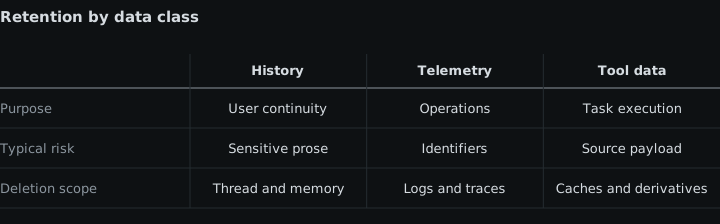
Data retention boundaries are the rules that decide which parts of an agent run are stored, where copies may exist, and what event makes each part expire. The boundary belongs to each field and derived store, not to the run as a single object.
A useful policy does not begin by choosing a duration. It begins by identifying the data, the reason for keeping it, the event from which retention is measured, and every place deletion must reach. No universal duration can be inferred from the supplied sources, so this reference does not prescribe one.
One run contains three retention classes
Conversation history, operational traces, and tool payloads have different purposes and should not inherit one retention period. They may appear together in a trace viewer, but that shared presentation is not a shared purpose.
A conversation can contain user messages, model responses, instructions, attachments, and selected prior context. Its product purpose may be continuity: letting a user reopen a thread or letting an agent continue work. If continuity is not a product requirement, retaining the transcript merely because tracing already captured it has no stated operational purpose.
An operational trace records execution. It may identify the run, parent and child operations, timing, model calls, tool calls, status, and errors. Its purpose can be incident investigation, service diagnosis, or reconstruction of an agent action. That purpose is narrower than preserving everything the user or a tool said. A team working on agent-run replay and debugging should specify the minimum fields needed for its chosen replay fidelity instead of treating full payload capture as the definition of a trace.
A tool payload is the request sent to a tool or the result returned from it. It can contain far more data than the agent needs: a database row, document body, search response, API error, or credentials returned by a provisioning operation. The payload exists to complete an operation and perhaps to support a narrowly defined investigation. That does not automatically justify storing it for as long as trace metadata.
These classes also have different storage costs. Conversation history grows with user-visible content. Trace metadata grows with operations and retries. Tool payload storage grows with the size of external results, often independently of either message count or model output. Keeping them together makes it hard to reduce one cost or exposure without damaging another use.
The practical boundary is therefore not merely three tables. Fields within each class may still require separate treatment. A trace identifier can remain useful after a prompt body has expired. A tool name and status can support reliability analysis without the returned document. A conversation title can remain in a user interface after message content has been removed, provided the title itself still has an approved purpose.
Conversation history is product state
Conversation history should be retained only when an approved product or operational function needs it. Define whether a conversation is a user-visible record, temporary model context, durable agent state, or some combination of those. Those roles should not be collapsed.
Model context is what is supplied to a model for a particular call. It may be assembled from the current message, earlier messages, summaries, retrieved memory, and tool results. A copy used as model context does not become durable conversation history simply because it crossed the model boundary. Conversely, deleting the visible transcript is incomplete if a summary or memory derived from it continues to be supplied on later runs.
Durable facts needed between runs belong under an explicit agent memory and state policy. That policy should say which facts may be extracted, how they remain linked to their source, and whether deleting the source also deletes or recomputes the memory. Without that link, a transcript can disappear while its assertions continue to affect the agent.
Retaining full conversations has a concrete cost: more content must be protected, searched, exported, and deleted. It is the wrong default when the product does not offer conversation continuity or when a narrower state record satisfies the operational need. Keeping only a summary is not automatically narrower if that summary preserves the sensitive substance of the source.
Operational traces are evidence about execution
Operational traces answer questions about what ran: which operation called which dependency, in what order, with what status, and under which run identity. They should be designed as operational evidence rather than as an automatic duplicate of conversation content.
The OpenTelemetry generative-AI semantic-conventions entry, accessed August 26, 2026, distinguishes areas including agent spans, model spans, events, and MCP server activity; the entry also states that the conventions have moved to a dedicated repository. That vocabulary helps teams inventory telemetry, but it does not assign retention periods. Instrumentation shape and retention policy remain separate decisions.
Separate structural trace data from content-bearing fields. Structural data includes relationships and execution facts such as operation identity, parentage, timing, status, and component names. Content-bearing fields include prompts, responses, tool arguments, tool results, and exception text that reproduces input. A backend may store both in one span record, but the policy still needs to identify them separately.
Full content can make a particular run easier to reconstruct, but it increases storage, access-control, and deletion work. It is the wrong default when identifiers, status, timing, and a redacted error category answer the operational question. When exact replay genuinely requires content, document that purpose and restrict the eligible runs or fields instead of silently promoting all production traffic into a replay corpus.
Sampling does not replace retention. Sampling decides which records enter a store; retention decides how long the accepted records and their derivatives remain. A sampled trace containing a complete prompt or tool result still needs field-level purpose and deletion handling.
Trace exporters and observability backends also need an explicit boundary. The application policy is ineffective if one component removes content while an exporter, queue, or backend keeps the original event under a different default. Record which system first receives each field, which transformations occur in transit, and which system is authoritative for expiry.
Tool results cross a separate trust boundary
Tool payloads should be governed separately because they originate in systems with their own schemas and access rules. An agent may need one value from a result while the tool returns an entire object. Retaining the entire response because extraction happened later preserves data that was never required for conversation continuity or trace diagnosis.
The OWASP LLM application security project page, accessed August 26, 2026, points to its current 2026 release and identifies risks including sensitive-information disclosure, insecure output handling, and excessive agency in its archived list. A retention design should therefore treat tool inputs and outputs as content requiring an explicit purpose, not harmless diagnostic text.
Validate and reduce a result before it enters model context where the integration permits it. The rules for validating agent tool results should also decide which representation may be logged: the raw payload, a validated subset, structural metadata, or only a status. Validation and retention solve different problems, but the validated subset is often a clearer retention unit than the vendor response.
Raw tool payload retention has three direct costs. It consumes storage according to external response size, widens the data available to anyone who can read traces, and expands the work required for deletion. It is the wrong answer when a result is reproducible from the source system, when metadata is sufficient to diagnose failures, or when the response includes unrelated fields.
Errors deserve the same treatment. An exception string can embed a request body, response excerpt, file path, identifier, or secret. Classifying a field as an error does not provide a purpose for retaining everything serialized into it. Store a controlled error code and approved diagnostic fields where those are sufficient.
Every retained field needs a purpose
A retention policy needs a legal or operational purpose for each field rather than a single duration for the entire trace. The NIST Privacy Framework, accessed August 26, 2026, describes itself as a voluntary tool for identifying and managing privacy risk through enterprise risk management. Applying that approach to agent data means making purpose and governance visible at the field and store level.
The policy record should contain enough information to execute, review, and test the decision:
| Policy element | What must be recorded |
|---|---|
| Data field | The exact content or metadata covered, not merely the name of a database or trace |
| Data class | Conversation history, operational trace, tool payload, or derived data |
| Purpose | The approved legal or operational reason for keeping the field |
| Collection point | Where the field first enters the system |
| Stores and processors | Every destination that receives the field or a derived representation |
| Retention trigger | The event from which expiry is calculated, such as creation or conversation closure |
| Duration | The approved period for this field and purpose |
| Disposition | Delete, aggregate, anonymize, or retain under a documented exception |
| Deletion key | The identifier used to locate originals and derivatives |
| Owner | The role accountable for the purpose and its continued need |
| Verification | The test or evidence showing that expiry and deletion reached the declared scope |
The purpose must be specific enough to disprove. Keep for debugging is incomplete: it does not identify which failures, which fields are necessary, or when the evidence stops being useful. Keep for compliance is also incomplete unless the applicable requirement and covered fields have been identified by the responsible legal or compliance owner.
One field can have more than one approved purpose, but each purpose needs its own scope. The effective retention decision must account for those scopes without turning the longest period anywhere in the record into the duration for everything. If only an identifier is required for one purpose, that purpose does not justify preserving the associated content.
A duration without a trigger is ambiguous. Retention measured from message creation behaves differently from retention measured from conversation closure or incident resolution. Name the trigger in the policy and persist the information required to evaluate it.
A policy also needs an exception path. If an authorized hold or investigation suspends ordinary deletion, record its scope, owner, start condition, and release condition. Do not implement exceptions by changing the default duration for every record.
Deletion includes derived stores
Deletion must cover derived stores such as embeddings, caches, and evaluation examples, or the visible record disappears while copies remain. This is a data-lineage requirement: the system must know what was created from the source and how to find it later.
An embedding is derived from content but can remain in a vector index after the source message is removed from the conversation database. A cache can preserve a model response or tool result after the originating trace expires. An evaluation example can copy a complete interaction into a dataset with a new identifier and a different owner. Deleting only the visible transcript leaves those representations outside the action.
The deletion key must therefore travel with derivation. A derived record needs either a durable link to its source or membership in a deletion group that can be resolved from the source identity. Content hashes alone are insufficient when content is normalized, chunked, summarized, redacted, or combined before derivation.
Use stable internal identifiers to connect the conversation, run, span, tool operation, and derived records. The design for correlation identifiers across agent runs should support lookup without placing user content or mutable external identifiers inside the correlation value.
Deletion propagation should cover records created before and during the deletion request. Otherwise, a queued embedding or evaluation job can recreate a derivative after the source has been erased. The deletion workflow needs a way to prevent or remove that late write, then verify the final state.
Caches need an explicit disposition even when they expire automatically. Record the cache key relationship, expiry behavior, and whether an active invalidation operation exists. Waiting for normal expiry is a retention decision and must match the approved policy; it is not equivalent to immediate deletion.
Evaluation examples require their own purpose review. Moving a conversation into an evaluation set changes the store and operational use, but it does not erase the source relationship. If continued evaluation use is approved after source deletion, that exception must describe the transformation and why the retained representation no longer falls within the deletion scope. Without such a decision, the evaluation copy should follow the source.
Deletion across derivatives costs engineering time and may reduce debugging or evaluation material. That cost is part of the design, not a reason to omit the stores from policy. The wrong implementation is a user-interface deletion that removes the primary row while leaving search indexes, caches, and evaluation copies untouched.
Minimize before retention begins
The cleanest retention boundary is a field that never enters a durable store. Decide at collection time whether content must be recorded, whether a reduced representation is enough, and whether redaction can occur before export. Redacting a viewer after ingestion does not remove the original from the backend.
Keep access policy aligned with purpose. A role allowed to inspect service timing does not thereby need conversation bodies or raw tool results. Separate content-bearing fields where the storage system permits it, and log access to retained content if that is part of the approved control design.
Encryption and access restrictions protect retained data but do not answer why it is retained or when it should be deleted. Likewise, aggregation or anonymization is a disposition only when the resulting record no longer preserves the data that the deletion request or expiry rule covers. The policy should name the transformation and its verification method rather than assuming a label changes the data.
A concrete policy record
Consider an agent run containing a user request, two model calls, and a tool result. The conversation store keeps the user-visible request and final response for an approved continuity purpose. The trace store keeps run relationships, operation names, timing, status, and controlled error codes for an approved diagnostic purpose. The raw tool result is used during execution but is not written to durable telemetry because no approved purpose requires it.
If the conversation is embedded for retrieval, the vector record carries the conversation identifier and follows the conversation deletion rule. If a reviewed interaction is copied into an evaluation set, the evaluation record preserves a source link and names its separate purpose, owner, trigger, and disposition. A cache entry records enough linkage to be invalidated when the source expires.
That design does not require all fields to share a duration, and it does not assume that deleting the conversation row completes deletion. It makes each retention decision inspectable: what is kept, why it is kept, what event starts expiry, where derivatives exist, and how removal is verified.
What to check next
Review the data map against actual instrumentation, exporters, model gateways, tool adapters, caches, vector indexes, and evaluation pipelines. For every content-bearing field, confirm a named purpose, owner, trigger, duration, deletion key, derivative list, and verification method.
Then test the boundary with a representative run. Locate the conversation, its trace metadata, tool records, embeddings, cache entries, and evaluation copies; execute the applicable expiry or deletion action; and verify every declared disposition. Repeat the test when instrumentation, storage backends, or evaluation pipelines change. A retention policy is complete only when the implemented data flow and deletion evidence match the written field-level rules.
Sources
- OpenTelemetry generative-AI semantic-conventions entryopentelemetry.io
- OWASP LLM application security project pageowasp.org
- NIST Privacy Frameworknist.gov
See also
Compare developer machines, team-operated servers, and managed services by state, identity, isolation, cost, reproducibility, and blast radius.
Limit agent reads, isolate enforcement, treat build-file writes as execution, gate deletion, and pair disk controls with network egress policy.
When a while loop around a model call beats an agent framework, what frameworks actually supply, and the three requirements that flip the answer.
How to preserve intent, prevent duplicate work, trace execution, and recover failures when agents hand tasks to other systems.