Operational kill switches for autonomous agents
- Author
 Gregory MostizkySoftware Engineer
- Published
- Section
- AI Agents
- Length
- 13 min read3 sources cited
An operational kill switch is an independent control path that stops an autonomous agent from starting or continuing unsafe work. Define measurable thresholds, decision owners, and switch scope before deployment; stop admissions, revoke tool credentials, contain active runs, preserve evidence, maintain a non-agent fallback, and require explicit evidence before redeployment.
A kill switch is an operational control
An operational kill switch is a control path that can prevent an autonomous agent from starting new work and stop or contain work already in progress. It is part of the deployed system, not a prompt telling the agent to stop and not merely a guardrail around one model call.
The distinction matters because an agent can continue affecting external systems after its current model call ends. It may have queued work, delegated tasks, issued tool requests, opened transactions, or retained credentials. A complete switch therefore controls the agent’s authority and workload, not just its process.
A kill switch is also broader than human escalation. OpenAI’s practical guide to building agents, accessed August 26, 2026, recommends human intervention when an agent exceeds predefined retry or action limits and before sensitive, irreversible, or high-stakes actions. Those controls can stop one run before a risky action. The operational switch must also handle the case where the deployment, a tool, a policy, or a class of active work can no longer be trusted.
Define the decision before the incident
Define measurable deactivation thresholds, named decision owners, and the scope of each switch before an incident rather than deciding under pressure. A runbook that says to disable the agent if it behaves badly leaves the incident team to decide what counts as bad, who has authority, and how much of the system to stop while the problem is still developing.
A threshold definition needs a measured condition and an action. Record:
- the signal being measured;
- the population or time window to which the measurement applies;
- the value or state that crosses the threshold;
- whether crossing it triggers automatic deactivation or a human decision;
- the switch that must be activated;
- the person or role that owns the decision;
- the backup owner if the primary owner is unavailable;
- the evidence required to clear the threshold and redeploy.
The signal must come from something the control plane can observe without asking the agent to assess itself. Otherwise, the same failure that makes shutdown necessary can prevent the threshold from being reported. Suitable signals depend on the agent’s intended use and risks; the page cannot supply universal values because no measurements were provided. The operational requirement is that each deployed agent has values chosen from its own evaluation and monitoring record, not that every agent shares one threshold.
Thresholds should correspond to consequences the organization has already decided it will not accept. They can cover repeated execution failure, unauthorized tool use, actions outside the approved task scope, loss of required audit data, inability to validate a high-risk result, or an incident in a dependency that invalidates the agent’s operating assumptions. The exact measurements and limits remain unverified until the team derives and tests them for that deployment.
One threshold need not disable every capability. The declared response might stop one tool, one workflow type, one tenant, one agent version, or the whole service. That scope must be written next to the threshold. Without it, an operator may choose a switch too narrow to contain the event or shut down unrelated work unnecessarily.
Ownership needs the same precision. The decision owner is the person or on-call role authorized to activate the switch, keep it active, and approve movement into recovery. Name the technical operator separately if that person only executes the decision. Document the communication path for security, legal, operational, and product owners whose systems or users are affected.
The NIST AI RMF Core, accessed August 26, 2026, calls for documented roles and communication lines, safe decommissioning procedures, and assigned responsibilities for superseding, disengaging, or deactivating systems whose performance or outcomes conflict with intended use. That makes ownership and deactivation part of governance before deployment, not an improvised production response.
The switch needs its own control plane
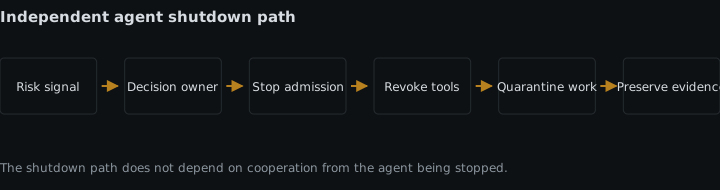
The control plane must remain independent of the agent and be able to stop new admissions, revoke tool credentials, and cancel or quarantine active work. Independence means the switch does not depend on the agent’s model, prompt, planner, memory, tool-selection logic, or cooperation. The operator must still be able to use it when the agent is looping, compromised, unreachable, or producing misleading status.
The switch’s command path should also avoid the agent’s normal execution path. If both depend on the same queue consumer, scheduler, process, or permission that has failed, the stop command can wait behind the work it needs to stop. The control path needs its own authenticated operator entry point and direct authority over admission, credentials, and workload state.
Stopping new admissions closes the front door. The scheduler, API, event consumer, or workflow trigger must reject or hold new tasks before they become agent runs. Disabling only the user interface is insufficient when events, retries, webhooks, scheduled jobs, or internal services can still enqueue work. The admission control should cover every trigger recorded for that agent deployment.
Credential revocation removes the agent’s ability to act through tools. Stopping a worker does not invalidate credentials copied into another process, attached to delegated work, or already presented to an external service. The control plane therefore needs a path to disable the agent identity, revoke its active tool credentials, or remove its authorization at the tool boundary.
This is easier to operate when the agent has its own identity rather than borrowing a person’s. A separate identity lets responders remove the agent’s authority without locking out the human fallback, and it keeps the incident record attributable. The design belongs with the broader decision about agent identity and audit, while the mechanics and exposure window of replacement credentials belong in the procedure for rotating agent secrets.
Revocation must cover each place where authority is enforced. Removing a secret from the agent’s configuration prevents future processes from loading it, but it does not necessarily invalidate a credential already issued or cached. The kill-switch inventory should identify the credential issuer, the tool-side authorization rule, the running workloads holding credentials, and the operator action that removes access at each boundary.
Active work requires an explicit terminal or containment state. Cancellation asks a run to stop and is appropriate only when the orchestrator and tools can confirm that no further side effect will occur. Quarantine prevents the run from progressing while preserving its state and evidence for review. If cancellation cannot be confirmed, mark the run unresolved rather than treating a submitted cancellation request as proof that it stopped.
The control plane must account for work outside the main agent process. That includes delegated runs, retry queues, scheduled callbacks, in-flight tool calls, and external jobs the agent already created. The switch may be unable to undo an action that an external system has accepted. Its job is then to prevent further authority, identify the outstanding effect, and hand that item to incident response.
Independence also applies to status. An operator needs control-plane evidence that admission is closed, credentials are no longer valid, and each active run is cancelled, quarantined, completed under observation, or unresolved. An agent-generated message saying it has stopped is not confirmation.
The practical cost is another production component with separate permissions, monitoring, ownership, and tests. That cost is part of running an autonomous agent. A switch implemented inside the agent loop is cheaper to add, but it cannot satisfy the independence condition and should be treated as a local guardrail rather than the operational kill switch.
Scope every switch deliberately
A single global off button is not a complete control design. Record the boundaries over which every switch acts: deployment, agent version, product environment, tenant, workflow, tool, credential set, queue, and active-run population. The exact dimensions depend on the agent deployment topology, because the components that admit and execute work change when the agent runs on a developer machine, a server, or a managed service.
The narrowest switch should contain the condition represented by its threshold. A tool-specific authorization failure calls for removing that tool’s authority from affected runs. Evidence that the orchestrator cannot enforce cancellation calls for stopping admission to the affected execution path. A condition that invalidates the agent’s policy or auditability can require disabling the full deployment. These are scope rules, not claims that one scope is generally preferable.
Scope also needs inheritance. If a global switch is active, a narrower workflow or tenant setting must not reactivate work beneath it. If a tool credential is revoked, retrying the run must not silently issue a replacement unless recovery has explicitly permitted that action. The effective state should therefore be the most restrictive applicable state until the decision owner clears it.
Every scope needs a known effect on active and pending work. A label such as disabled is incomplete unless operators know whether queued tasks remain queued, are rejected, or move into quarantine; whether active work receives cancellation; and whether credentials are revoked. Those semantics belong in the runbook and in the switch’s observable status.
Shutdown must preserve a recoverable state
A shutdown procedure should preserve evidence, account for downstream effects, provide a non-agent fallback, and require explicit redeployment criteria. The procedure is finished only when the team can establish what stopped, what may still act, what users or systems need attention, and what evidence would permit operation to resume.
Preserve evidence before cleanup destroys it. Retain the control-plane event that activated the switch, its threshold and observed value, the decision owner, operator actions, configuration and agent version, run identifiers, tool requests and results, credential events, queue state, and the final disposition of active work. Keep original records separate from later analysis so investigators can distinguish what the system recorded during the event from conclusions reached afterward.
Evidence preservation does not authorize indefinite retention. Incident records still sit within the deployment’s agent data retention boundaries. The shutdown plan should identify which existing policy covers traces, model inputs and outputs, tool results, credentials, and user data, and who can place an authorized hold when forensic, regulatory, or legal review requires it.
Account for downstream effects rather than assuming that stopping the agent reverses its work. For each active or recently completed run, determine whether a tool accepted a request, whether an external job remains scheduled, whether data was written, whether a message or transaction was emitted, and whether another system will retry or continue the workflow. Record each effect as confirmed complete, confirmed not executed, contained, reversed by an authorized process, or unresolved. Do not infer the state from the agent’s last message.
Downstream review also covers users and dependent teams. The incident owner needs to know which requests were rejected or left pending, which outputs should not be consumed, and which systems must be told that the agent’s results are quarantined. Communication follows the actual scope of the switch and the evidence available; it should not claim that all effects were contained while unresolved work remains.
Provide a non-agent fallback for any function that must continue during shutdown. The fallback may be a human procedure, a non-agent service, or a controlled backlog that waits for later processing. It must not depend on the disabled agent to interpret tasks, supply credentials, or explain prior state. Required access and operating instructions need to be available to the people who take over.
The fallback gives shutdown somewhere safe to send new demand. Without it, operational pressure can turn into pressure to reactivate the agent before the incident is understood. The fallback’s capacity and limits should be declared in advance so owners know which work can continue and which work must pause.
The NIST AI RMF Manage Playbook, accessed August 26, 2026, says deactivation protocols should minimize operational disruption and downstream negative impacts, include contingency options, preserve material for forensic, regulatory, and legal review, and establish criteria for redeployment. It also ties bypass or deactivation decisions to documented thresholds, impact review, root-cause analysis, and consideration of upstream and downstream consequences.
Redeployment must be a new explicit decision, not the automatic inverse of shutdown. Clearing an alert or restoring a process does not show that the condition that crossed the threshold has been removed. Before redeployment, the decision owner should require evidence that:
- the triggering condition and affected scope have been identified;
- unresolved active work and downstream effects have an accepted disposition;
- revoked authority will not return unintentionally;
- the change intended to address the condition has been evaluated against the relevant threshold;
- admission, cancellation, quarantine, revocation, evidence capture, and fallback paths still operate;
- monitoring can detect recurrence;
- the approved version, scope, credentials, and initial admission level are recorded.
If any item cannot be established, keep the affected scope disabled or reduce it to the explicitly approved boundary. Components that cannot meet the redeployment criteria remain decommissioned and preserved as required by the evidence plan.
Verify the control, not just the button
A kill switch is unproven until an exercise shows that its effects reach the whole declared scope. Test it against an inventory of admission paths, worker pools, queues, agent identities, credentials, tools, delegated work, and external jobs. The test result should show observed state changes at those boundaries, not only a successful response from the switch endpoint.
The exercise should include work in different states: waiting for admission, queued, running between model calls, waiting on a tool, delegated, retrying, and already accepted by an external system. The expected result for each state must match the documented cancellation or quarantine semantics. Where an external action cannot be cancelled, the exercise should demonstrate detection and handoff to the downstream-response owner.
Test the control path while the normal agent path is unavailable. Confirm that the operator can authenticate, locate the correct scope, activate the switch, and read status without using the agent. Confirm separately that the non-agent fallback can receive the work it is meant to handle and does not rely on revoked agent credentials.
Exercise decision ownership as well as software. The primary and backup owners should be able to find the threshold, identify the applicable scope, reach the operator, preserve evidence, and state who may authorize redeployment. Record any ambiguity as a control defect; an undocumented judgment discovered during a drill will be harder to resolve during an incident.
Review the switch whenever the deployment gains a new trigger, tool, credential issuer, queue, worker pool, delegation path, or external job type. A control that covered the original architecture can become incomplete as the agent’s authority expands.
What to look up next
For each deployed agent, the next records to inspect are its risk thresholds, control-plane dependency map, trigger and queue inventory, agent identity, tool credential inventory, active-work state model, evidence-retention policy, downstream-system owners, fallback procedure, and redeployment gate.
The implementation is ready for review when an operator can answer four questions from those records without consulting the agent: what condition activates the switch, who owns the decision, exactly which authority and work it stops, and what evidence is required before that scope can run again.
Sources
- OpenAI’s practical guide to building agentscdn.openai.com
- NIST AI RMF Coreairc.nist.gov
- NIST AI RMF Manage Playbookairc.nist.gov
See also
How to measure a coding assistant's effect on an engineering team: what acceptance metrics miss, why DORA is safe to publish, and when to capture a baseline.
How credit metering behaves under agent-driven work: one credit spans three axes, the window is rolling 30 days, and the limit arrives as errors.
What model routing does, what the decision costs, why heuristic routing beats classifier routing at small margins, and why fallback routing comes first.
How to bind tenant identity to storage, caches, tool checks, runtime state, and quotas without mistaking logical partitioning for isolation.