Diagnose MCP Protocol Version Mismatches
- Author
 Joseph TrasattiMember of technical staff
- Published
- Section
- MCP
- Length
- 6 min read3 sources cited
Log the initialize request and response, compare both protocolVersion values against the client’s supported set, and use the negotiated value on every later HTTP request. If the server selects a version the client cannot run, close the connection. Do not continue by assuming adjacent dated versions are compatible.
The server returns a different version
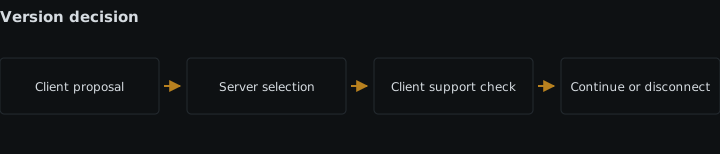
Symptom: The client sends an initialize request with one protocolVersion, but the server’s InitializeResult contains another. The connection may be reported as incompatible even though the response itself is valid.
Likely cause: The client or its diagnostics assume the server must echo the proposed version. That is required only when the server supports the proposal. Under the dated MCP lifecycle and version-negotiation rules, checked 2026-08-26, the client proposes a version it supports—normally its latest—and the server may answer with another version it supports when it cannot accept that proposal. The server should normally select its own latest supported version.
That response is a selection, not proof that the two implementations have found a common version. The client still has to compare the returned value with the versions it actually implements. Protocol negotiation also differs from capability negotiation: the version chooses the protocol contract, while capabilities determine which optional features may be used within that contract.
Check: Capture the complete JSON-RPC request and response for initialize. Record these two fields without normalizing them:
InitializeRequest.params.protocolVersionInitializeResult.protocolVersion
Then compare both values with explicit client and server supported-version lists from the running builds. If the values differ, verify whether the server supports the client’s proposal. If it does, returning a different value violates the negotiation rule. If it does not, the different response is expected and the next question is whether the client supports the selection.
Also confirm that initialize was the first protocol interaction. The wider ordering, including the later notifications/initialized message, belongs to the MCP initialization lifecycle.
Fix: Make the client propose the latest version it genuinely implements, not the newest version string known to a dependency or configuration file. Make the server echo that value when supported; otherwise, return a version the server genuinely supports. Keep the client’s supported set explicit so the response can be checked before normal operation begins.
Initialization succeeds, but the next HTTP request fails
Symptom: The initialize exchange completes, but a later Streamable HTTP request is rejected with 400 Bad Request or behaves as though it belongs to a different protocol version.
Likely cause: The subsequent request is missing MCP-Protocol-Version, carries the original client proposal instead of the server-selected value, or takes its value from a global build constant. The dated Streamable HTTP protocol-version header rules, checked 2026-08-26, require every HTTP request after initialization to carry MCP-Protocol-Version: <protocol-version>. The value should be the version negotiated during initialization. A server receiving an invalid or unsupported value must return 400 Bad Request.
The header lets the server interpret and reject traffic according to the negotiated contract. It is not interchangeable with MCP-Session-Id: the session header identifies related requests, while the protocol header states which MCP version those requests use. The mechanics of retaining the session identifier are covered separately in Streamable HTTP session management.
Check: Capture the first HTTP request after InitializeResult, then inspect every later POST or GET in the same session. For each request, write down:
- The exact
MCP-Protocol-Versionheader value. - The exact
InitializeResult.protocolVersionvalue. - Any
MCP-Session-Idsent with the request. - The HTTP status returned by the server.
The first two values must match exactly. Check the request as it leaves the final proxy or HTTP middleware layer, not only the client object before serialization; that is where a header can be dropped or replaced. If a load balancer routes requests among server builds, repeat the capture for each failing route rather than assuming all instances support the same versions.
Fix: Store the server-selected protocol version in per-session state as soon as InitializeResult is accepted. Generate MCP-Protocol-Version from that state for every subsequent HTTP request. Do not regenerate it from the client’s preferred version, an SDK default, or the current specification date. If the server rejects the exact negotiated value, inspect whether the request reached a server instance with a different supported-version set; repair that deployment mismatch or start a new initialization against a compatible instance.
The client continues after an unsupported selection
Symptom: The trace shows the server returning a protocol version outside the client’s supported set, followed by notifications/initialized or normal-operation messages from that client.
Likely cause: The client treats the server-selected version as advisory and guesses that nearby dated versions are compatible. Negotiation does not grant that permission. A successful JSON-RPC response only tells the client what the server selected; it does not add that version to the client implementation.
Check: Put a decision point immediately after decoding InitializeResult and before sending notifications/initialized. Test membership using the client’s explicit supported-version set:
selected = InitializeResult.protocolVersion
continue only if selected is in clientSupportedVersions
Exercise the check with one supported returned value and one unsupported returned value. For the unsupported case, verify that no initialized notification, tool request, resource request, or prompt request leaves the client. This check measures the behavior that matters; a warning log followed by normal traffic is still incorrect.
Fix: If the server-selected version is not supported, the client must close the connection rather than continue with guessed compatibility. The specification’s normative wording is SHOULD disconnect; for an implementation troubleshooting an unknown contract, treat that as a stop condition. Update one side until there is an explicitly supported common version, then begin a new initialization. Do not reuse the failed negotiation or patch only the header, because neither action gives the client an implementation of the selected protocol.
An upgrade did not remove the mismatch
Symptom: A team upgrades for the 2025-11-25 specification revision but sees the same disagreement during initialization or on subsequent HTTP requests.
Likely cause: The upgrade was treated as evidence that both endpoints now support the same version. The 2025-11-25 MCP key changes, checked 2026-08-26, describe changes since 2025-06-18 but do not list a change to the version-negotiation mechanism. A package update and a supported protocol version are separate facts.
Check: Ignore package release dates for one diagnostic run. Capture the proposed version, selected version, client-supported set, server-supported set, and post-initialization HTTP header. That five-value record distinguishes a negotiation failure from a header propagation failure.
Fix: Declare supported protocol versions from implemented behavior and test the full handshake at the deployment boundary. Accept normal operation only when the server’s selection belongs to both supported sets and every later HTTP request carries that exact selection. If either condition fails, stop at that boundary; tool-call debugging starts only after version negotiation and header propagation are correct.
Sources
- MCP lifecycle and version-negotiation rulesmodelcontextprotocol.io
- Streamable HTTP protocol-version header rulesmodelcontextprotocol.io
- 2025-11-25 MCP key changesmodelcontextprotocol.io
See also
Implement bidirectional MCP cancellation, stop costly work, suppress cancelled responses, and handle completion races without protocol errors.
Negotiate support, reread resources after update notifications, and remove subscription state when interest or the MCP session ends.
How MCP servers advertise URI templates, attach template-level metadata, and turn user or model input into concrete resource reads.
How MCP clients declare relevant filesystem roots, report changes, and rely on operating-system controls to enforce access.