Content-Aware Cropping vs Fixed Crop Rules
- Author
 Joseph TrasattiMember of technical staff
- Published
- Section
- No-Code
- Length
- 7 min read3 sources cited
Use fixed crop rules when source composition is controlled and repeatability matters. Use content-aware gravity for a heterogeneous library because image analysis can adapt the focal region per asset. In production, pair automation with a fallback focal point or manual override whenever the detected subject may not match the editorial subject.
The decision
Fixed crop rules and content-aware cropping solve different versions of the same delivery problem. A fixed crop applies a predetermined framing rule. Content-aware gravity analyses each image and selects a focal region before cropping.
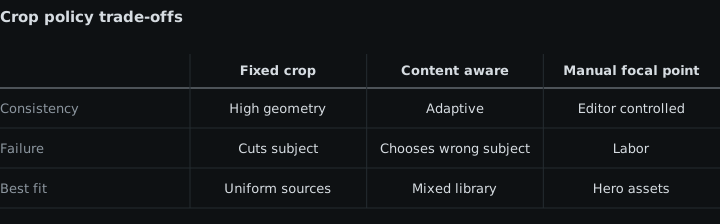
Pick fixed rules when source composition is controlled and the same instruction should produce the same framing every time. Pick content-aware gravity when compositions vary enough that a fixed rule can cut off the subject. For a heterogeneous library, the practical choice is content-aware cropping with a fallback focal point or manual override—not unattended automation with no exception path.
This choice belongs in the delivery layer of media handling inside no-code application builders. It does not require editors to create a separate crop for every destination, but the no-code workflow still needs an explicit policy for automatic results that frame the wrong subject.
Comparison at a glance
| Criterion | Fixed crop rule | Content-aware gravity | Content-aware with override |
|---|---|---|---|
| Determinism | Applies the fixed rule consistently | Focal region depends on image analysis | Uses analysis by default, with an explicit exception path |
| Variable source composition | Does not adapt; the subject can be cut off | Adapts the focal region across a heterogeneous library | Adapts most assets and lets an editor correct exceptions |
| Editorial intent | Preserves the chosen rule, whether or not it suits an individual image | May identify a visible subject that is not the editorial subject | Lets editorial intent replace the automatic choice when necessary |
| What you give up | Adaptation to composition | Guaranteed agreement with editorial intent | Fully hands-off operation for exceptional assets |
There is no supported basis here for comparing speed, price, or accuracy rates. The supplied sources provide no benchmark for those criteria, so they should not decide this choice.
Fixed crop rules: predictable when inputs are predictable
A fixed crop rule is a standing instruction about how an image should be framed. The mechanism is simple: the delivery workflow applies that instruction without reconsidering the composition of each source asset. That makes its behaviour deterministic.
Cloudinary’s resizing and cropping documentation, checked 2026-08-18, describes cropping as part of the delivery transformation. The important operational consequence is that a fixed rule remains fixed even when the input changes. Determinism describes the instruction, not the quality of every result.
That distinction decides where fixed crops fit. If source images follow a controlled composition, the fixed instruction can preserve a repeatable frame. The workflow does not have to infer which region matters. That is useful when repeatability is itself the requirement.
The same mechanism becomes the downside when the library contains materially different compositions. A rule that suits one source can cut off the subject in another because it does not adapt to where the subject appears. The workflow is behaving correctly; the rule simply lacks information about the new image.
Fixed crops are therefore the wrong answer when the source library is heterogeneous and keeping the subject in frame matters more than repeating one predetermined instruction. They are also a poor substitute for upload policy. File size, dimension, and duration guardrails decide what the workflow accepts; they do not make a fixed crop understand composition.
Content-aware gravity: adaptation without editorial understanding
Content-aware gravity changes the mechanism. Instead of relying only on a predetermined crop position, it uses image analysis to select a focal region. The crop can therefore respond to the composition of each source image.
Cloudinary’s automatic gravity selection documentation, checked 2026-08-18, is the source for this behaviour. The supported advantage is specific: content-aware gravity can adapt across a heterogeneous library. It addresses the exact condition that causes fixed rules to fail—important content appearing in different parts of different images.
This makes content-aware gravity the stronger default when a no-code workflow receives mixed source compositions. The rule remains centrally configured, but the selected focal region can vary per asset. That is adaptation, not determinism: two differently composed sources need not be framed around the same relative area.
The cost is a gap between visual analysis and editorial intent. The automatic subject can be a genuine subject in the image without being the subject the page is trying to emphasise. Image analysis selects a focal region; it does not receive unstated editorial priorities merely because the transformation runs inside an editorial workflow.
That limitation makes content-aware gravity alone the wrong answer when every automatic choice must be assumed to match editorial intent. The supplied facts do not establish an accuracy rate, so there is no defensible threshold at which exceptions can be dismissed. The workflow needs a defined response for assets where the automatic subject is not the editorial subject.
The production choice: automatic default, explicit exception
A hybrid policy combines content-aware gravity with either a fallback focal point or a manual override. The automatic analysis handles variation across the library. The exception path supplies editorial direction when analysis chooses the wrong emphasis.
Cloudinary’s image transformation documentation, checked 2026-08-18, places cropping within the broader transformation system. For this comparison, the useful design principle is to keep the adaptive crop as the default while making the exception an explicit part of the transformation workflow.
A fallback focal point and a manual override serve the same failure condition but imply different handling:
- Use a fallback focal point when the workflow can apply a predetermined editorial focus after the automatic result is rejected.
- Use a manual override when an editor must choose the intended focus for that particular asset.
Neither changes the reason for using content-aware gravity. The library is still heterogeneous, and automatic focal selection still reduces the mismatch caused by applying one fixed crop everywhere. The override exists because the subject detected from image content is not guaranteed to be the subject intended by the editor.
The concrete cost is exception handling. Someone must define the fallback or supply the manual choice for affected assets, and the no-code flow must expose a place for that decision. If it cannot represent an override cleanly, that is a signal to examine when a no-code media automation should become code, rather than silently accepting the wrong crop.
A workable no-code policy
Start by classifying the source library, not by choosing the more sophisticated option.
- If composition is controlled, set a fixed crop rule and verify that the chosen framing suits the allowed sources.
- If composition varies, make content-aware gravity the default so focal selection can adapt per asset.
- Define the exception condition plainly: the automatically selected subject is not the editorial subject.
- For that condition, provide a fallback focal point or a manual override.
- Keep crop selection separate from automatic format and quality delivery. Those delivery choices do not resolve which part of an image should remain in frame.
This policy avoids two common category errors. Deterministic does not mean composition-aware, and automatic does not mean editorially correct. Fixed rules guarantee consistent application of the rule. Content-aware gravity supplies adaptation. The override supplies editorial control when adaptation points at the wrong subject.
Which to pick when
Pick a fixed crop rule when source composition is controlled and deterministic framing is the requirement. Its behaviour is easy to reason about, but it is the wrong choice for varied compositions because it can cut off the subject.
Pick content-aware gravity when the library is heterogeneous and the crop must adapt to where image analysis finds a focal region. Do not treat that automatic choice as editorial judgment.
For a varied production library, pick content-aware gravity with a fallback focal point or manual override. That combination uses analysis where fixed rules are weakest and preserves a correction path for the assets where the automatic subject is not the editorial subject.
Sources
- Cloudinary’s resizing and cropping documentationcloudinary.com
- automatic gravity selection documentationcloudinary.com
- image transformation documentationcloudinary.com
See also
How a design-tool plugin keeps a media library as source of record: live placement, publishing back, source vs rendition, who owns latest, who approves.
Limit payloads at every block, keep personal data out of logs, and record exactly what external analysis services receive.
Set up perceptual duplicate detection as a flag-only automation, budget the sweep as an add-on, and stop most duplicates earlier with deterministic public IDs.
How folder mode limits a no-code integration’s library access, why dynamic folders preserve asset URLs, and when to decide the structure.