Data Minimization in No-Code Media Flows
- Author
 Joseph TrasattiMember of technical staff
- Published
- Section
- No-Code
- Length
- 12 min read3 sources cited
Minimize data at every block boundary: send only required fields, treat logs and errors as retained data stores, and document every media item and metadata field sent to external analysis services. Preserve enough identifiers for operation and debugging, but make every additional field an explicit, reviewed choice.
Data minimization belongs at every block boundary
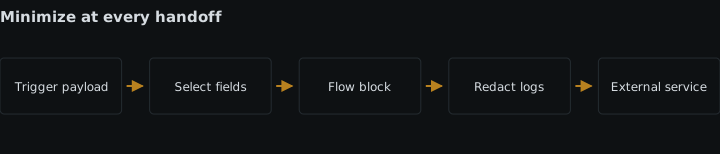
Data minimization in a no-code media flow means limiting each block, branch, log, and external call to the media and metadata needed for its declared job. It is a field-by-field and boundary-by-boundary design rule, not a cleanup performed only on the final asset.
The NIST Privacy Framework, accessed August 26, 2026, treats privacy as an enterprise risk-management problem. Applied to media automation, that means examining the whole path data takes: the trigger, intermediate blocks, parallel branches, external services, error handlers, notifications, and execution history.
A flow is not minimized merely because its published output contains little personal data. A source payload may still have crossed blocks that did not need it, reached an external service, or remained visible in a failed execution long after the final asset was cleaned.
Pass only the fields each block needs
A flow should pass only the fields each block needs instead of forwarding the entire webhook or asset record. Treat every connection on the canvas as a data contract: it should carry a declared set of inputs for a declared purpose.
This requires more than hiding unused fields in the block editor. If a complete payload remains available to a block, the data boundary is still broad even when the block uses only one value. Create a smaller object or select individual variables before the boundary where the platform permits it. If the platform cannot narrow an object, record that limitation rather than describing the connection as minimized.
Cloudinary’s PowerFlow building documentation, last updated August 18, 2026, describes flows as connected functional blocks with configurable inputs. An input can be a fixed value, a flow variable, a flow secret, or a response value from an earlier block. The same documentation says execution history exposes individual block outputs and that error paths can reference a failing block’s error. Those controls make deliberate field selection possible, but the person building the flow must decide what each boundary is allowed to carry.
For each block, write down:
- the job the block performs;
- the exact inputs required for that job;
- the fields it returns;
- which returned fields the next block may receive;
- whether its input, output, or failure details appear in a log;
- whether any part of the operation leaves the primary platform.
This record does not need to reproduce the whole payload. A compact allowlist is more useful because it shows the intended contract. Terms such as “asset data,” “webhook body,” or “metadata” are too broad to review. Name individual fields or a defined nested object.
The cost is configuration and review time. A pass-through payload is quicker to wire because later blocks can reach anything in the original record. A narrow payload makes later changes explicit: when a block genuinely needs another field, the allowlist must change. That friction is useful because it turns a new disclosure into a visible design decision.
Minimization must not remove data required for the flow to perform its job. Keep the identifiers needed to correlate an operation, update the correct asset, or investigate a failure. The rule is not “carry as little as possible” in the abstract; it is “carry no more than the declared operation requires.” If nobody can explain why a field crosses a boundary, exclude it.
When mapping an automation for the first time, place this field contract beside the block diagram described in building a first media automation flow. The diagram shows where processing happens; the contract shows what data is permitted to move between those points.
Narrow every branch independently
A branch creates a new disclosure path. Do not assume that data approved for one branch is automatically appropriate for its siblings.
A branch that updates an asset and a branch that sends a notification perform different jobs. Each needs its own allowlist, even when both begin with the same trigger. Construct the branch-specific payload before the split where practical. Otherwise, each downstream block may inherit every field present at the branch point.
The same rule applies after branches rejoin. Build the merged payload from the outputs needed by the next block. Do not restore the original trigger record merely because it is convenient to reference. A merge is another boundary at which unnecessary fields can be dropped.
Conditional logic also deserves review. A condition may inspect a field without sending that field farther down either branch. Keep the decision result and any necessary correlation value; do not forward the inspected value unless a later block needs it. The treatment of branch inputs, fall-through cases, and merged outputs belongs in the design of branching conditions in no-code flows, not as an undocumented property of the canvas.
Branch-specific minimization costs some duplication because two branches may need separate mappings. The alternative is a shared oversized object whose permitted uses are difficult to distinguish. Duplicate the small contracts when the purposes differ; shared convenience is not a reason to expand both branches.
Run logs may contain more personal data than the asset
Run logs and error captures can retain more personal data than the final asset because they preserve intermediate payloads. A flow may remove metadata from its published result while its execution history still contains the original trigger, an earlier block response, a request body, or a failure object.
This makes observability part of the data design. Logs are not outside the flow merely because they appear in an administrative sidebar. Anyone reviewing exposure must include platform execution history, explicit logging blocks, webhook notifications, connected chat channels, external monitoring tools, and copied diagnostic material.
The useful debugging record is normally a small account of what happened: a flow identifier, execution or correlation identifier, block name, status, time, and a deliberately bounded error category. The complete input and output should not be the default diagnostic record. When a case requires inspecting a payload, treat that capture as an exception with a named reason, restricted access, and a defined removal point.
Avoid composing log messages from a complete block response. Selecting one harmless-looking property from an object is different from serializing the object and relying on the log viewer to hide fields. Redaction after capture leaves the unredacted data present somewhere in the pipeline unless the platform documents otherwise.
Error paths need the same discipline. A provider response or exception can echo submitted data, request fragments, media locations, or metadata. Forwarding the raw error to another block, a webhook, or a team chat can therefore duplicate the original disclosure. Extract the status and bounded diagnostic information needed to route or alert. Preserve the full error only when an investigated case justifies it and the destination is approved for that data.
This restraint has a concrete cost: a minimized log may not contain enough detail to solve every incident without reproducing it. Decide what routine diagnosis requires and retain that small set. Use a controlled, temporary capture for the exceptional case rather than keeping every payload in anticipation of an unknown failure.
Do not invent a retention period. The supplied Cloudinary build document explains how to inspect current and past executions, but it does not state a retention duration on that page. Until the applicable platform documentation or contract supplies a dated value, record retention as unverified. The same applies to deletion behavior, backup persistence, residency, and export controls.
Access matters alongside retention. Limit who can open execution history, modify logging blocks, redirect errors, or add a notification destination. Those permissions belong in the review of who can edit a no-code automation, because an editor can change both the processing logic and where diagnostic data goes.
Separate secrets from working data
A secret is not an ordinary flow field. A credential may be necessary for an external block to authenticate, but it should be referenced through the platform’s secret mechanism rather than copied into a payload, variable, log message, error notification, or inventory value.
Minimizing personal data does not compensate for exposing a credential, and protecting credentials does not minimize the media or metadata sent with an authenticated request. Review the two concerns separately. The field contract records working data; the secret record identifies the credential reference, its owner, and the system it authorizes without recording the secret itself.
Follow the separate controls for managing secrets inside no-code flows when a block calls another service. In the data inventory, name only the credential reference or connection name. Never paste its value into the document used for privacy review.
Inventory every external AI or analysis boundary
External AI or analysis blocks need an explicit inventory of which media and metadata leave the primary platform. The block label is not enough. “Generate description,” “moderate,” or “analyze image” names an activity, not the data transferred to perform it.
The inventory must distinguish the media itself from its surrounding metadata. Record whether the service receives uploaded bytes, a derivative, or a retrievable media location. Separately list every metadata field sent with the request. Do not summarize those fields as “context.” Context is precisely where names, free text, internal classifications, location data, or other unnecessary material can cross the boundary unnoticed.
The OWASP Top 10 for Large Language Model Applications project page, accessed August 26, 2026, points to the current 2026 release and preserves sensitive-information disclosure as a documented risk class. For a no-code flow, the first control is knowing exactly what reaches the model-facing or analysis service. Output filtering cannot undo an unnecessary input disclosure.
Use an inventory with fields specific enough to approve:
| Inventory field | What to record |
|---|---|
| Flow and block | Stable flow identifier and the exact external block |
| Trigger condition | The condition under which data leaves the platform |
| Destination | Provider, service, and configured endpoint or connection |
| Media sent | Original, derivative, bytes, or retrievable location |
| Metadata sent | Explicit field names, including nested fields |
| Purpose | The operation each media item and field supports |
| Response retained | Exact returned fields kept by the flow |
| Downstream destinations | Blocks, logs, notifications, and systems receiving the response |
| Credential reference | Connection or secret name, never the secret value |
| Provider terms | Dated links for verified retention, training, residency, and deletion terms |
| Unverified points | Any policy or behavior for which no dated primary source is available |
| Reviewer and review date | Who accepted the boundary and when it was checked |
This is a disclosure inventory, not a copy of vendor marketing or a generic integration catalog. One provider may appear more than once when different blocks send different media, metadata, or derivatives. Conversely, several blocks can share an entry only when their destination, permitted fields, purpose, and handling are genuinely identical.
Do not state a provider’s retention, training, deletion, or residency behavior from memory. Link a dated primary source in the inventory. If the applicable term cannot be verified, mark it unverified and make the deployment decision with that gap visible.
The media selection should also be justified. If an operation can work on a derivative, the inventory should say which derivative is sent and why it is sufficient. If the original is necessary, say what property of the operation requires it. Do not claim that a derivative is anonymous or safe merely because its dimensions or quality changed; minimization reduces the submitted material but does not prove that a person is unidentifiable.
External analysis results need their own allowlist on return. A service may produce more fields than the final asset requires. Select the result fields that drive the next block, and keep provider diagnostics out of the asset record and routine logs unless they serve a declared operational purpose.
The inventory costs maintenance. It must change when a block changes provider, endpoint, model, requested fields, media variant, response mapping, or log behavior. A flow whose external boundary cannot be described at field level is not ready for approval. If the no-code platform hides the request or makes the boundary impossible to control, record that constraint and consider whether the automation should become code.
Review the intermediate system, not only the output
A complete review follows data from entry to deletion rather than inspecting the final asset alone. It covers the trigger payload, selected variables, branch-specific objects, external requests, returned analysis, error paths, run history, notifications, and temporary diagnostic captures.
The field contract and external-boundary inventory should be versioned with the flow or in a repository that records changes. A canvas screenshot helps orient a reviewer, but it cannot show all nested fields, runtime values, or provider terms. Keep the screenshot as a map and the allowlists as the reviewable specification.
Testing should use records that do not introduce unnecessary personal data. A production payload copied into a test run can create another retained execution and another set of external requests. Use a deliberately bounded fixture where the platform permits it, then verify the log and error views as well as the successful output. The question is not only whether the flow completes; it is whether each boundary contains only its approved fields.
Change review should reopen the relevant contract whenever someone:
- adds or replaces a block;
- maps a new field from a trigger or earlier response;
- changes a branch condition or merge;
- adds logging, error handling, or a notification destination;
- changes an external service or the media sent to it;
- retains another field from an analysis response.
A visual editor can make these changes look local. Their data effect may extend through every downstream block that receives the enlarged object. Review the downstream path, not just the edited block.
What to verify before enabling the flow
Confirm that every block has an explicit purpose and input allowlist; every branch narrows data for its own job; logs and error paths exclude full payloads by default; and each external AI or analysis call appears in the disclosure inventory. Check the actual execution history after a bounded test, because the canvas alone does not show everything the runtime records.
Then look up the current platform and provider documentation for access to logs, retention, deletion, backup persistence, residency, training use, and subprocessor handling. Attach dated primary links to the inventory. Where the documentation does not answer a question, write “unverified” and keep that uncertainty in the approval record.
The final check is simple to state: every field crossing every boundary must have a named job, and every retained copy must have a named operational reason. Anything else should be removed, narrowed, or recorded as an unresolved platform constraint.
Sources
- NIST Privacy Frameworknist.gov
- PowerFlow building documentationcloudinary.com
- OWASP Top 10 for Large Language Model Applications project pageowasp.org
See also
Set up perceptual duplicate detection as a flag-only automation, budget the sweep as an add-on, and stop most duplicates earlier with deterministic public IDs.
How folder mode limits a no-code integration’s library access, why dynamic folders preserve asset URLs, and when to decide the structure.
Build a no-code generative fill workflow that keeps originals, records prompts, routes risky edges for review, and publishes traceable derivatives.
Create, document, test, version, and retire upload presets without breaking no-code media workflows that reference them.