Manage Secrets in No-Code Automation Flows
- Author
 Joseph TrasattiMember of technical staff
- Published
- Section
- No-Code
- Length
- 12 min read3 sources cited

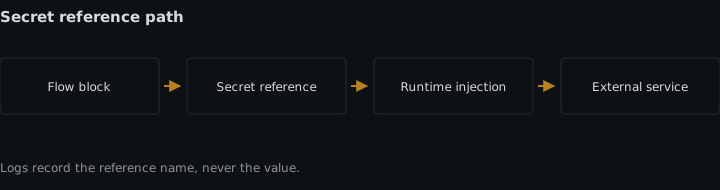
Store each credential in a secret store and bind blocks to its name, never its value. Check successful and failed runs, exports, and screenshots for disclosure. For rotation, create the replacement, update every reference, test the flow, then revoke the old secret. If redaction cannot be proved, keep the credential outside the flow.
Prerequisites
Before editing the flow, you need permission to change its stored secrets and the ability to create and revoke the credential at its source. You also need a safe test input whose expected result you can recognize. If the only available test performs an irreversible production action, add a guarded test path or test the integration outside the live flow first.
Identify who owns the credential and who can approve revocation. Do not put the value in a ticket, worksheet, chat message, or diagram while collecting this information. Record only the secret’s reference name, its purpose, its source system, and the blocks that consume it.
Steps
-
Map every place the flow needs a credential
Start at the trigger and inspect each block in execution order. Record any API token, webhook signing secret, password, private key, or connection credential the block needs. Include success paths, error paths, notification blocks, and branches that run only under particular conditions.
For each credential, write down:
- the stored-secret name;
- the blocks that reference it;
- the test and production environments that need separate values;
- the person or team allowed to rotate it;
- the operation that proves the credential works;
- the operation used to revoke it.
Never add the secret value to this inventory. The inventory is meant to survive in documentation and change history; storing values there creates another secret store without the access controls or redaction behavior of one.
This mapping is not optional when several branches share a credential. Rotation fails when the obvious HTTP block is updated but a retry, notification, or error-handling branch still points to the old reference. Conversely, a flow that does not need a credential should not receive one. Remove unused references instead of keeping them for possible future work.
-
Choose the storage boundary before configuring blocks
Use the no-code platform’s protected, flow-scoped secret storage when one flow owns the credential. Use a protected shared connection when several flows deliberately use the same integration identity. Use an external secrets manager only when the automation platform can retrieve or resolve the secret without exposing the retrieved value in block configuration or output.
The OWASP Secrets Management Cheat Sheet, accessed August 26, 2026, treats creation, rotation, revocation, and expiration as one lifecycle. It also calls for least-privilege access, automated rotation where possible, and masking or encryption that prevents plaintext secrets from entering logs. That lifecycle is the reason to separate the stored value from the flow definition: the credential can change without rewriting every parameter that uses it.
The conditions decide which boundary is suitable:
- A flow-scoped secret suits a credential used by one automation. Its main cost is repeated setup when several flows need distinct copies. It is the wrong choice when all of those flows must rotate one shared identity together.
- A shared protected connection suits several flows that intentionally share an identity. Its cost is a larger impact from a mistaken change or revocation. It is the wrong choice when each flow needs separate permissions or separate incident containment.
- An external secrets manager suits an organization that already centralizes access control and rotation. Its cost is another integration and a bootstrap identity that must itself be protected. It is the wrong choice if the no-code platform can only receive the retrieved value as visible text or log it as ordinary block output.
An environment variable, ordinary flow variable, text field, or JSON configuration is not an acceptable substitute merely because its name contains
SECRET. Use it only if the platform explicitly protects the value from editors, outputs, exports, and logs. -
Create a stable name and store the value once
Give the secret a name that describes its purpose and environment, such as
CATALOG_API_TOKEN_PROD. The name may be visible to flow editors, so do not include any part of the credential in it. Separate test and production names even if the blocks are otherwise identical; that makes an accidental cross-environment binding visible during review.Enter the credential only in the platform’s protected secret dialog. Do not paste it into a block first and plan to move it later: saves, version history, screenshots, or exports may preserve the earlier parameter.
A flow should reference a stored secret by name rather than place the credential in a visible block parameter. Cloudinary’s PowerFlow builder documentation, last updated August 18, 2026, says a block input can use a fixed value or a variable, including a flow secret, and describes selecting variables through the input field’s variable picker. In a MediaFlows PowerFlow, choose the flow-secret reference in that picker. The block should display the reference, not the underlying API key or secret.
Use a flow secret when the value belongs only to that PowerFlow. If the credential represents a reusable third-party connection, first determine whether the platform’s protected connection facility is the intended storage boundary. A plain fixed value is the wrong answer in both cases because anyone who can inspect the block can see or copy it, and the value becomes part of the editable flow definition.
-
Keep secret values out of agent and assistant inputs
If a model-assisted builder, Workflow Agent, assistant, or MCP server is used to create or edit the flow, provide the stored-secret name and the block that should consume it. Do not provide the value in a prompt, tool argument, example payload, or debugging transcript.
The OWASP Top 10 for Large Language Model Applications, accessed August 26, 2026, identifies prompt injection and sensitive-information disclosure as separate risks. For a flow builder, the practical boundary is straightforward: a model may help place
CATALOG_API_TOKEN_PROD, but it does not need the token behind that name.This costs one manual action when the generated flow reaches the authentication field: a person with the right access must bind or approve the protected reference. That separation is useful. It prevents the credential from becoming part of the conversation, generated flow description, or tool trace.
Asking an agent to recover a credential from another block, log, file, or screenshot is also the wrong answer. If the reference cannot be resolved through an approved secret facility, stop and configure that facility rather than routing the value through the model.
-
Audit every output surface before using the live credential
Secret values must be redacted from run logs, error messages, exports, and screenshots. Redaction means the value is absent or replaced with a non-reversible placeholder. Collapsing a panel, hiding a field with CSS, or cropping a screenshot does not change data already present in an export or log record.
Begin with a non-secret marker stored through the same secret mechanism. Trigger a controlled authentication failure and inspect every output the platform produces. A unique marker lets you search outputs without putting a live credential into the test. Then bind the real secret only after the data path is understood.
Check these surfaces separately:
Surface Test Passing condition Run logs Inspect the authentication block on a successful and failed run The reference name or a redaction marker may appear; the stored value does not Error messages Cause a controlled authentication failure The error explains the failed operation without echoing credentials, authorization headers, or a request containing them Notifications Trigger the same failure through each enabled notification path The notification contains enough context to locate the run but no secret value Exports and shared definitions Export or share the flow, then inspect the resulting definition The definition contains a reference or an empty binding, never the stored value Screenshots and recordings Capture the configuration and failure investigation views used in documentation No value, reveal control, clipboard preview, request dump, or adjacent secret is visible Inspect nested data, not only the top-level log message. HTTP blocks may expose request headers, request bodies, retries, or a vendor response inside expandable details. Error paths can also turn a failing block’s error into input for a logging or notification block. Pass only a status, block name, correlation identifier, or deliberately selected diagnostic field into those paths; do not forward an entire request or error object without inspecting it.
Apply the same rule to payloads. Data minimization across no-code media automation blocks reduces the number of fields that can be copied into logs or downstream systems, but it does not replace secret redaction. A minimal payload can still be unsafe if one remaining field is a credential.
If any tested surface exposes the marker, assume it would expose the real value. Reconfigure the block, disable that output, or move the authenticated operation behind a component with enforceable redaction. Do not continue on the assumption that reviewers will remember to delete logs or blur screenshots later.
-
Bind the reference and run success and failure tests
Replace the marker with the real value in protected storage, leaving the block bound to the stored-secret name. For an HTTP integration, put the reference only in the authentication field or header that requires it; the procedure for calling external APIs from no-code HTTP request blocks should not turn the credential into a general-purpose flow variable.
Run one test that should authenticate and complete the intended operation. Verify the external effect, not merely the flow’s green status. Then run a safe failure case and confirm that the error path behaves as designed. Review the outputs from both runs against the redaction checks in the previous step.
A successful request proves that the current reference resolves to a usable credential. The failure test proves that diagnostics do not reveal it when operators are most likely to open logs, copy an error, or take a screenshot. Both conditions matter; testing only the happy path leaves the highest-risk output path unexamined.
If the platform cannot prevent a secret from appearing in either path, the visual flow is the wrong place to make that authenticated call. Put the credential behind a controlled service or webhook handler and let the flow call an endpoint that exposes only the operation it needs. That adds a component to operate, but it moves secret handling to code where request logging, response shaping, and access checks can be enforced.
-
Rebind secrets after an import or environment promotion
Treat the flow definition and its secret values as separate release items. The definition may carry a secret’s name so blocks remain understandable, but it must not carry the value. Inspect every exported artifact before it is attached to a ticket, committed, emailed, or imported elsewhere.
When importing or exporting a no-code flow definition, record which references need destination values. In the destination product environment, create the protected secret, update each block to the destination reference, and test there. Do not make a production flow resolve a test credential merely to avoid this binding step.
Apply the same sequence when moving an automation from a test environment to production: import the definition, create or select production secrets, update references, test with a controlled production-safe input, inspect outputs, and only then enable the production trigger.
The cost is an explicit per-environment binding and test. That is preferable to an export containing usable credentials or a copied flow silently calling production with a test identity. Assuming that an import safely carries secrets is the wrong answer unless the platform’s current documentation explicitly guarantees both protected transfer and the required destination access controls.
-
Rotate with an overlap, a reference update, and a test
For scheduled rotation, keep the old credential valid while establishing the replacement. Rotation needs a reference update and a test run before the old secret is revoked. Use this order:
- Create the replacement credential at its source without revoking the current one.
- Store the replacement as a new protected secret with a distinct reference name.
- Use the inventory from step 1 to update every consuming block, branch, retry, and notification integration to the new reference.
- Run the known success test and verify the intended external effect.
- Run the safe failure test and repeat the log, error, export, and screenshot checks.
- Confirm that no enabled flow still references the old stored-secret name.
- Revoke the old credential at its source.
- Remove the obsolete stored secret after confirming that rollback no longer requires it, and update the inventory with the completed rotation.
The overlap temporarily leaves two valid credentials, which is the concrete cost of avoiding an untested cutover. Keep that interval limited to the update and verification work. Revoking first is wrong for routine rotation because every run fails until the replacement is stored, referenced, and proven. Overwriting a value in place without testing is also wrong: it removes the clear distinction between the old and new bindings and makes incomplete updates harder to find.
Confirmed exposure is a different condition. If a live secret appears in a log, error, export, screenshot, or model conversation, treat it as disclosed. Preserve required audit evidence without preserving the plaintext secret, stop or disable the affected flow where possible, and follow the credential owner’s incident revocation procedure. Do not extend the old credential’s life merely to complete a routine overlap. Bind and test a replacement before re-enabling the affected automation.
Expected result
The completed flow contains readable secret reference names but no credential values in visible block parameters. Successful runs authenticate through protected storage. Failed runs, notifications, exports, and screenshots reveal no secret values. Test and production environments resolve separate references. A routine rotation creates a replacement, updates every reference, passes a test run, and only then revokes the old secret.
Sources
- OWASP Secrets Management Cheat Sheetcheatsheetseries.owasp.org
- PowerFlow builder documentationcloudinary.com
- Top 10 for Large Language Model Applicationsowasp.org
See also
Move a production no-code flow from employee ownership to a service principal, preserve every binding, and prepare rotation and emergency transfer.
Choose signed or unsigned Cloudinary upload presets by client path, parameter control, and the guardrails a public no-code flow can enforce.
How strict transformation allowlists block unknown no-code delivery variants, preserve approved ones, and change the release process.
How to test a media automation safely: a separate product environment, a representative asset set, and failure branches broken on purpose before it goes live.