Incoming vs Eager Transformations in No-Code Pipelines
- Author
 Joseph TrasattiMember of technical staff
- Published
- Section
- No-Code
- Length
- 12 min read3 sources cited

Use incoming transformations only when the stored asset itself must be changed and you accept losing discarded source detail. Use eager transformations when you must retain the uploaded original while preparing named delivery variants before first request. Never repeat the same operation at both stages: it wastes processing and may transform twice.
The decision in one sentence
Pick an incoming transformation when changing the stored original is the requirement. Pick an eager transformation when preserving the uploaded original and having named delivery variants ready before their first request are both requirements.
That distinction is about where an operation sits in the asset lifecycle, not two interchangeable ways to express the same recipe. An incoming transformation runs before storage. The transformed result becomes the stored original, so any source detail removed by the operation is gone from that stored asset. An eager transformation keeps the uploaded original and creates specified delivery variants in advance.
Do not solve the choice by enabling both stages for the same operation. Cloudinary’s upload-preset guidance, checked 2026-08-26, warns that repeating a transformation in incoming and eager settings causes redundant processing or unexpected results. In practical terms, the pipeline spends processing on an operation it has already performed and may apply the operation twice.
| Criterion | Incoming transformation | Eager transformation | Same operation in both |
|---|---|---|---|
| Stored original | Stores the transformed result; discarded source detail is not recoverable from that original | Preserves the uploaded original | The eager stage starts from an original already changed by the incoming stage |
| Variant readiness | Does not, by itself, preserve the upload and prepare named delivery variants | Prepares named delivery variants before the first request | May produce a variant transformed again rather than the intended once-transformed result |
| Processing | Performs the operation before storage | Performs specified variant work ahead of delivery | Repeats work and wastes processing |
| Right condition | The stored asset must conform permanently, and losing removed detail is acceptable | The source must remain available and known variants must be ready early | No normal condition; split distinct operations between stages instead |
What the two stages actually mean
The useful mental model is a fork in the pipeline:
Incoming:
uploaded asset → operation → stored original

Eager:
uploaded asset → stored original
               └──────→ named delivery variant A
               └──────→ named delivery variant B
The first line has no preserved branch around the operation. If that operation removes detail, changes dimensions, or otherwise narrows what the asset contains, the stored original contains only the result. Later delivery work can start from that result, but it cannot recover information no longer present there.
The eager path has a preserved source and one or more prepared outputs. Its defining benefit is not that it performs a different class of operation. Its benefit is placement: the original remains intact while the selected delivery variants are made before anyone requests them.
Cloudinary’s eager and incoming transformation documentation, checked 2026-08-26, defines the same boundary: eager assets are generated in addition to the uploaded original, while an incoming transformation changes the original before Cloudinary stores it. That storage boundary should decide the setting.
For a no-code workflow, write the requirement without naming either feature:
- Must the asset kept in storage be the uploaded source or the processed result?
- Is losing detail removed by the operation acceptable for every later use?
- Must particular named delivery variants exist before their first request?
- Does any operation appear in more than one stage?
Those four questions are enough to choose and audit the pipeline without relying on the labels used by a particular visual builder.
Incoming transformations: choose permanence deliberately
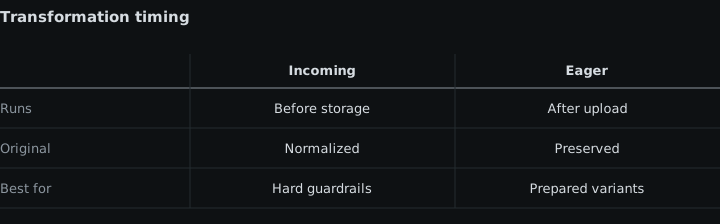
An incoming transformation changes the asset before storage. The processed output becomes the stored original. This is the correct mechanism when the storage requirement itself says the source must be changed, rather than merely saying that a particular presentation needs a changed version.
The cost is irreversible loss within the stored original. If the operation discards source detail, that detail cannot be recovered from the asset later. A new delivery transformation cannot recreate information that the incoming stage removed. Reversing a visual recipe is therefore not the same as recovering the upload.
That makes incoming processing suitable only under a strong condition: every permitted downstream use can start from the changed asset. The requirement should survive questions from teams and workflows that do not yet exist. If a later destination could need the source detail, incoming is the wrong stage for the detail-removing operation.
This is especially important in media handling inside no-code application builders. A builder may present an upload step and a delivery step as adjacent blocks, but the storage boundary between them still matters. A configuration that looks like a display rule can become a permanent source change if placed in the incoming stage.
Before choosing incoming, record three statements in the workflow description:
- The exact operation that runs before storage.
- The detail the operation may discard.
- The reason no later destination needs that detail.
If the team cannot complete the third statement, do not put the operation in incoming. Preserve the uploaded original and move presentation-specific work to eager variants instead.
Incoming is also the wrong answer when the actual requirement is first-request readiness. Changing the stored original does not satisfy the separate requirement to prepare named delivery variants. Treating it as a substitute confuses source policy with delivery preparation.
Finally, incoming is wrong when an equivalent operation already appears in the eager recipe. Removing the eager copy is not automatically the right fix; first decide whether the operation belongs to the stored original or only to delivery. Keep it in exactly the stage that matches that decision.
Eager transformations: preserve first, prepare known outputs
An eager transformation preserves the uploaded original and prepares named delivery variants ahead of the first request. Choose it when both parts matter: the source must remain available, and the delivery pipeline already knows which variants it will need.
The mechanism is additive. Storage keeps the upload, while eager processing creates the named outputs beside it. Later work can still begin from the original because the eager stage did not replace that original with one of its variants.
The main cost supported by this comparison is processing committed to every configured eager operation. That work happens because the pipeline has chosen to prepare the variant, not because the first request has proved the variant necessary. Do not turn that into an unsupported cost estimate: no benchmark or per-variant measurement was supplied for this page. The defensible statement is narrower—each configured eager operation is work the pipeline elects to perform in advance.
Eager is the better fit for a fixed set of known presentations. For example, if a workflow must retain a source asset while preparing named variants for two established destinations, eager matches both conditions. The number two is part of the example, not a platform limit.
It also gives brand-standardisation workflows a clean separation between the retained source and named delivery outputs. The brand treatment belongs in an eager variant if editors may need the untreated source later. Putting the same treatment into incoming would change what the system regards as the original.
Eager is the wrong answer when the stored original itself is required to be the processed result. It can prepare a delivery variant, but the uploaded original remains preserved. That fails a requirement whose point is to make the stored asset conform permanently.
It is also the wrong answer when the workflow cannot name a delivery variant that must exist before first request. Eager processing is specifically preparation. If the pipeline owner cannot identify the output being prepared, adding an eager stage has no supported purpose under the criteria available here.
Use Cloudinary’s transformation reference, checked 2026-08-26, to verify the exact operation sequence assigned to each named variant. The reference is the place to check transformation semantics; it does not change the stage decision. First decide whether the source is replaced or preserved, then express the selected operation in the appropriate stage.
A split pipeline can be correct, but duplication is not
A workflow may contain both incoming and eager transformations when they do different jobs. The valid pattern is:
upload
  → incoming operation required for the stored original
  → stored original
      → eager operation for named variant A
      → eager operation for named variant B
The incoming step sets the permanent starting point. Each eager recipe then prepares a delivery output from that stored starting point. This split is defensible only if the team accepts that every eager variant begins after the incoming change and therefore cannot use any detail the incoming step discarded.
The invalid pattern is:
upload
  → incoming operation X
  → stored result of X
      → eager operation X again
Applying operation X in both places wastes processing. It can also produce an unexpected double transformation because eager processing receives an original that has already passed through X. The issue is not solved by giving the two configurations different labels. Compare the actual operations and their order.
Some repeated operations may produce an obviously different second result; others may look close enough to escape a quick visual check. The supplied evidence does not establish which operations are harmless when repeated, so do not maintain an exception list based on appearance. The safe configuration rule is simpler: one operation, one intentional stage.
When both stages are necessary, document the boundary in plain language:
- Incoming operations define what is permanently stored.
- Eager operations define which named variants are prepared.
- No eager recipe repeats an incoming operation.
This separation also makes review possible without opening every block in the no-code tool. A reviewer can compare two short inventories and identify duplicates before testing individual assets.
Audit the visual workflow by operation, not by block name
No-code pipelines often hide consequential settings behind friendly labels such as upload, optimise, prepare, or publish. Those names are not evidence of execution order. Audit the data flow itself.
Start with one representative asset and draw a line from ingestion to storage to each named output. At every processing block, write down:
| Audit field | Question to answer |
|---|---|
| Stage | Does this run before storage or prepare a delivery variant? |
| Input | Is it receiving the upload or the already transformed stored original? |
| Operation | What exact change is applied? |
| Stored effect | Does discarded detail disappear from the stored original? |
| Prepared output | Which named variant is ready before first request? |
| Duplicate check | Does the same operation appear at another stage? |
Do not accept a configuration merely because its preview looks right. A preview can show the desired output while leaving the wrong source policy underneath it. The meaningful test is whether the stored original and each named variant have the intended relationship.
Use these three acceptance checks:
- Original check: Retrieve or inspect the stored original. If incoming processing is configured, confirm that the team intended this processed result to be the original. If eager-only processing is configured, confirm that the upload remains the original.
- Variant check: Identify each named eager variant and confirm it is prepared before its first delivery request. This verifies the reason for choosing eager rather than merely proving that a transformed URL can eventually return an output.
- Single-application check: Compare incoming and eager recipes operation by operation. Any match is a defect until the pipeline owner removes it from one stage and explains why the remaining stage is correct.
For a pipeline using strict delivery rules, align this inventory with the strict transformation allowlist. The eager decision still rests on source preservation and variant readiness; the related allowlist determines which delivery transformations the application permits. Keep those decisions separate so an access rule does not accidentally become a source-changing rule.
Worked decisions
A reusable source with fixed publication variants
Suppose editors upload one asset that may be reused later, while the current application needs three named presentation variants ready before their first requests.
Pick eager transformations. The condition requiring preservation rules out an incoming detail-removing operation, and the requirement for three known, pre-request variants matches eager processing directly. Configure each intended operation in the eager recipe and leave it out of incoming.
The tradeoff is explicit: the pipeline performs the configured eager work in advance. What it does not trade away is the uploaded original.
A permanently constrained stored asset
Suppose policy says the stored original itself must be the result of operation X, and the team accepts that detail removed by X will not be recoverable from that original.
Pick an incoming transformation for X. An eager variant would preserve the upload, so it would not meet the storage condition. Do not also place X in eager. If named delivery variants are required, give those eager variants only the additional operations that define those outputs.
The tradeoff is permanent: later workflows start from the transformed stored original, not the discarded source detail.
A workflow with X in both stages
Suppose an existing preset applies X incoming and then includes X in every eager variant.
Pick neither duplicate. Decide where X belongs. Keep it incoming only if X must define the stored original and its information loss is accepted. Keep it eager only if the upload must remain available and X belongs to prepared delivery outputs. The current configuration wastes processing and risks a double transformation regardless of whether sample previews happen to look acceptable.
Which to pick when
Pick incoming when the processed result must become the stored original, every later use may start from that result, and the team explicitly accepts that discarded source detail cannot be recovered from the stored asset.
Pick eager when the uploaded original must remain intact and you can name the delivery variants that must be prepared before their first request.
Pick a split pipeline only when the incoming and eager stages contain distinct operations: permanent source changes first, delivery-specific variant work second.
Pick neither duplicate configuration when the same operation appears in both stages. Remove it from one stage. Its correct home follows from a single question: should the stored original already contain that change, or should the change exist only in prepared delivery variants?
Sources
- upload-preset guidancecloudinary.com
- eager and incoming transformation documentationcloudinary.com
- transformation referencecloudinary.com
See also
Build an asset loop from a fixed snapshot, preserve per-item outcomes, and cap concurrency so downstream APIs stay within their limits.
How no-code builders upload and deliver media: pre-built integrations, plain transformation URLs, one shared credential, and where signed requests stop.
Separate flow success from webhook delivery, stop duplicate processing, and log each attempt without exposing secret-bearing destination URLs.
Build an image-aware media flow that stores alt text and generation state per language, skips decorative images, and retries locales independently.