Strict Transformation Allowlists for No-Code Media
- Author
 Joseph TrasattiMember of technical staff
- Published
- Section
- No-Code
- Length
- 7 min read2 sources cited
Strict transformation allowlists stop a no-code delivery flow from creating arbitrary derived media from unfamiliar URL parameters. Approved and eagerly generated variants still deliver; unknown transformation strings fail. The control limits transformation abuse, but every new crop, size, format, or parameter ordering must be approved and released with the site change.
What strict transformation allowlists do
Strict transformation allowlists limit which derived media variants a Cloudinary product environment will generate. They are useful when a no-code site needs a fixed set of delivery sizes, crops, formats, or effects and should not accept arbitrary transformation strings supplied through public URLs.
Cloudinary normally creates a derived asset when a delivery URL containing transformation parameters is requested for the first time, then stores and caches that result. Its access-control documentation, checked 26 August 2026, explains how strict transformations constrain this URL-driven mechanism. A page can request a new width, crop, format, quality setting, or effect without preparing the variant first, unless strict mode rejects that unapproved transformation.
Strict transformations put an approval boundary around that mechanism. A request cannot generate an arbitrary derived variant merely because its transformation syntax is valid. This matters when a no-code builder exposes media URLs in generated markup, stores them in editable records, or lets workflow inputs influence delivery parameters. The builder can still request media, but Cloudinary decides whether the exact requested transformation may create a derived asset.
Allowed strings work; unknown strings fail
After strict transformations are enabled, an explicitly allowed transformation can still be generated and delivered on demand. Cloudinary’s media access-control documentation, checked 26 August 2026, says an unallowed transformation request returns a 404 response. The practical contract is therefore exact: approved delivery variants continue to work, while unknown transformation strings are rejected.
The comparison is based on the transformation representation, not only on the pixels that would result. Cloudinary documents w_300,c_scale and c_scale,w_300 as different transformations even though they produce the same output. It also distinguishes .jpg from .jpeg, and a format expressed through f_jpg from one expressed as a file extension.
That distinction is easy to miss in a no-code release. A builder update can reorder parameters, add an extension, or move a format choice into the transformation path without changing the intended appearance. Under a strict allowlist, the new string is a new delivery variant and fails until it is approved. Testing only the visual design in an environment without the production allowlist does not exercise this boundary.
Automatic values also need attention. Cloudinary states that a value such as dpr_auto can resolve at delivery time to concrete strings such as dpr_1.0 or dpr_2.0. Those resolved variants must be allowed, or the delivery URL must be signed. A responsive component whose output varies by device therefore needs its complete expected variant set accounted for; approving only the template visible in the builder may not cover the strings requested by browsers.
Eagerly generated variants remain available
A strict allowlist does not disable delivery of variants already created through an approved path. In particular, eager transformations can generate the required derived assets during upload, during an asset update, or later for an existing asset. Cloudinary’s eager and incoming transformation documentation, checked 26 August 2026, identifies eager generation as a way to prepare derived assets when strict transformations prevent their creation on first delivery.
This gives a no-code workflow two relevant states. An allowed transformation may be created when a visitor first requests it. An eager transformation is created before that visitor request and is then available for delivery. An unknown transformation string is neither approved nor prepared, so the request is rejected rather than creating another derived asset.
Eager generation has a concrete cost: it moves transformation work into the upload or release path and counts the processing request against the product environment’s transformation usage. Generating eager transformations for an existing asset through the explicit API is counted even when an identical derived asset already exists, according to the same documentation. Eager generation should therefore describe a known delivery inventory, not become a blanket request for every conceivable size.
Automatic format needs separate treatment in that inventory. Cloudinary states that f_auto does not create every possible format during eager processing because there is no requesting browser at upload time. If all format variants must exist in advance, the required formats have to be generated explicitly. Parameter order and extensions must also match the eventual delivery URL. These details make incoming versus eager transformations part of the delivery contract rather than an upload-only choice.
The abuse boundary
The control reduces transformation abuse by preventing an outside requester from producing an open-ended set of derived assets. Without the restriction, changing a valid transformation path can ask Cloudinary to process and retain another variant. With strict transformations enabled, unfamiliar strings fail instead of starting that work.
The boundary is transformation creation, not a general privacy rule. It does not by itself decide who may retrieve an original asset, and it should not be used as a substitute for the delivery type and signing rules covered under private and authenticated media assets. If the requirement is that only an authorized viewer may receive an asset, transformation approval alone does not express that requirement.
Nor does enabling strict transformations necessarily withdraw every derivative created earlier. Cloudinary warns that a derived asset generated while its transformation was allowed can remain accessible until the relevant cache is invalidated. Turning on the setting is therefore a control over new generation, with a separate transition question for variants and cached responses that already exist.
Release coordination becomes mandatory
The tradeoff is operational: the allowlist reduces unwanted generation, but every legitimate new delivery variant needs coordination. A design change from a 600-pixel card to a 640-pixel card is not only a page edit if width is encoded in the delivery URL. A new crop mode, quality component, output format, device-pixel-ratio value, extension, or parameter order can likewise produce a string that production has never approved.
The media change and its transformation approval must ship as one release. For eager delivery, the assets also need the new derivative generated before the page begins requesting it. Releasing the page first produces broken media; adding unused variants first broadens the approved set before the application needs it. The useful release unit is the page change, its exact delivery strings, the corresponding allowlist entries, and any required eager generation.
This is the main condition for choosing strict transformations in a no-code system. They fit when the site has a bounded delivery vocabulary and someone owns changes to that vocabulary. They are a poor fit when editors or end users are intentionally permitted to compose arbitrary dimensions or effects and there is no signing layer to authorize those requests. In that case, the behavior the product needs conflicts with a fixed allowlist.
A no-code builder should therefore be treated as a producer of transformation strings, not merely as a visual editor. Record the strings emitted by each reusable image, gallery, video, and responsive-media component. If media URLs can also be assembled by automations or database formulas, include those outputs in the same inventory. The wider integration boundary is covered in media handling inside no-code application builders.
What to verify before and after release
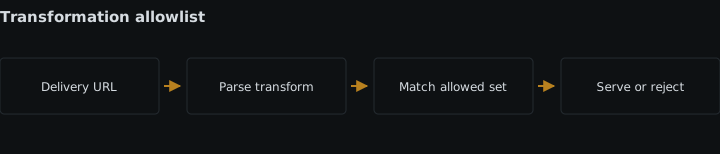
A production check should request a known allowed variant, a required eager variant, and a deliberately unknown variant. The allowed and eager requests should deliver the expected media. The unknown request should fail rather than create a derivative. Repeat the check for responsive and automatic-format paths whose final strings can differ by browser or device.
Release monitoring should distinguish a rejected transformation from a missing source asset or a failed workflow. A rise in media 404 responses after a builder change can mean that the emitted transformation vocabulary changed without the allowlist changing with it. That signal belongs alongside the workflow checks described in observability for no-code media flows.
The next facts to look up are the exact transformations produced by the live builder, which variants are generated eagerly, whether any delivery URL depends on automatic values, and who approves changes to that set. Those answers determine whether the allowlist is complete and whether a media-related site release can proceed without rejecting a legitimate delivery path.
Sources
- access-control documentationcloudinary.com
- eager and incoming transformation documentationcloudinary.com
See also
How to test a media automation safely: a separate product environment, a representative asset set, and failure branches broken on purpose before it goes live.
Configure public access windows or signed media URLs without letting clock skew or caches extend access.
How to set up a MediaFlows PowerFlow that deletes rejected user uploads after a grace period, covers derived copies, and logs every deletion for later evidence.
A hosted visual automation and a hand-written webhook handler weighed on setup cost, ongoing maintenance, who is allowed to edit, and version control.