Observability for No-Code Media Flows
- Author
 Joseph TrasattiMember of technical staff
- Published
- Section
- No-Code
- Length
- 13 min read3 sources cited
Operational observability pairs a flow’s visual definition with execution records showing what ran. Each record should capture the trigger, redacted block data, timing, retries, and outcome. A correlation identifier must follow every webhook and API call, connecting the no-code run to downstream logs and traces.
Operational observability for media flows
Operational observability is the record needed to explain how a no-code media flow was designed, what happened during a particular run, and where that run continued in other systems. It combines the flow definition, execution-level evidence, aggregate measurements, and identifiers that survive service boundaries.
The OpenTelemetry observability primer, last modified April 23, 2026, distinguishes logs, metrics, spans, and traces. Logs are timestamped messages; metrics aggregate numeric behavior over time; a span represents one operation; and a trace follows one request across services. A no-code platform need not expose every signal itself, but its run records must contain enough context to join the platform’s activity to signals emitted elsewhere.
The canvas records intent; run logs record execution
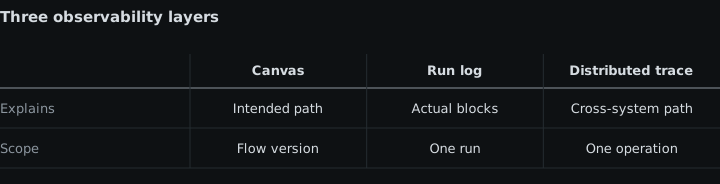
A visual canvas explains intended control flow while run logs explain what one execution actually did. These are complementary records, not interchangeable views of the same evidence.
The canvas is the design. It shows the configured trigger, connected blocks, branches, error paths, and values or variables wired into block inputs. It answers questions about what should happen: which block follows an upload event, which response feeds the next request, which work can run in parallel, and where a recoverable error is routed. That makes the canvas useful during review and while building a media automation from blocks.
The canvas does not prove that a block ran, received a particular value, retried, followed an error path, or completed. It also cannot show the response returned by an external service during one execution. Reading the configured path as though it were an execution trace can therefore hide the difference between intended behavior and observed behavior.
Run logs supply that missing execution record. The Cloudinary guide to building a PowerFlow, updated August 18, 2026, says its canvas can be used to view, edit, test, debug, and deploy a flow. After execution, its logs list runs with execution time and status; selecting a run shows the blocks that executed, and selecting a block shows its output for that execution. History logs expose past executions. Those details establish what the product documents as available, but they do not remove the need to define what an operationally sufficient record must contain.
A useful investigation moves between both records. The operator starts with the run, identifies the blocks that actually executed, and then reads the canvas to understand the configured path and the variables connecting those blocks. If the run stopped early, the absence of later blocks is execution evidence. If it followed an error path, the canvas explains why that path exists while the run record shows that this execution took it.
The flow definition can change after an incident. A run record should therefore identify the flow and the definition or revision that governed that run whenever the platform exposes such an identifier. Without that association, the current canvas may describe different control flow from the one that produced the recorded output. If revision identity is unavailable, that gap should be stated in the incident record rather than silently treating the current canvas as historical evidence.
Testing and production runs need the same distinction. A successful manual test shows what happened for the test trigger and its inputs. It does not establish that later event-triggered runs received the same data or took the same branches. Each production execution still needs its own record.
A useful run record has a defined field contract
Useful run records include trigger identity, block inputs and outputs after redaction, timing, retries, and final disposition. Capturing only a timestamp and a generic success or failure label leaves too many questions unanswered once the original payload and downstream logs have moved on.
Trigger identity ties the run to the event that started it. The record should name the trigger type and preserve the non-sensitive identifiers needed to distinguish that event from another event involving the same flow. Depending on the trigger, that may be an event identifier, request identifier, schedule occurrence, or media identifier already provided by the platform. The point is not to copy the entire trigger payload. It is to make the initiating event findable and to tell whether two records represent separate triggers, a duplicate delivery, or repeated handling of the same trigger.
Trigger identity must be recorded at the start of the run. If it is added only after later blocks complete, the executions that fail before that point become the least identifiable records precisely when they need the most scrutiny. When an upstream system supplies a correlation value, retain it separately from the platform’s own run identifier so either value can be searched.
Block inputs and outputs show the data that drove each operation and the result returned by it. Inputs explain why a conditional path was taken or why an external request had a particular shape. Outputs show what a transformation, lookup, analysis operation, webhook, or API call returned for that execution. Recording only outputs omits the decision context; recording only inputs omits the observed result.
Those values must be stored after redaction. Redaction means preserving the fields needed to explain behavior while removing secrets, credentials, personal data, and payload content that the investigation does not require. The log record can retain field names, data types, selected non-sensitive identifiers, status codes, and an explicit marker that a value was removed. A silent omission is harder to interpret because an operator cannot tell whether a field was absent at execution time or suppressed by logging policy.
Redaction should happen before the data enters durable logs or an external observability backend. Removing sensitive values from a dashboard later does not remove them from the underlying record, exports, indexes, or copies already sent elsewhere. The same field policy should apply to normal output, error output, retry records, and manually added log messages. Data minimization across no-code flow blocks is therefore part of the telemetry design, not a cleanup task performed after deployment.
Redaction has an operational cost: removing too much context can make a record inconclusive. The field contract should preserve the smallest stable identifiers and result metadata that can answer whether the correct object was handled, which branch ran, and what the external system returned. It should not preserve a complete media asset, an authorization header, a secret-bearing URL, or an unrestricted request body merely because those values are convenient during development.
Timing should cover the whole run and the blocks inside it. At minimum, retain a run start, a run end or last recorded activity, and the resulting duration. Per-block start, end, or duration values show where elapsed time accumulated and whether two connected blocks ran sequentially or in parallel. Use a consistent time basis and retain timestamps with enough context to order events across systems.
Timing is evidence of elapsed work, not an explanation by itself. A long block duration may include waiting on an external service, platform scheduling, or work performed inside the block; the run record can distinguish these only if the platform emits corresponding detail. Do not label an unmeasured component as the source of delay. Carry the correlation identifier into the outbound request and continue the timing investigation in the receiving system.
Cloudinary’s August 18, 2026 guide states that a PowerFlow times out after running for more than five minutes. That is a documented platform condition, not a general threshold for other no-code products. A timeout disposition should retain the last completed block and the last activity recorded before termination, because an overall duration alone does not show how far the run progressed.
Retries need their own execution evidence. A final successful response can conceal earlier failed attempts, extra downstream traffic, and added elapsed time. For each retryable operation, retain the attempt number, the result that led to another attempt after redaction, the delay before the next attempt when available, and the result of the final attempt. If retries occur inside the platform but their individual attempts are not exposed, record that visibility gap rather than reporting a single call as established fact.
Retry records must also distinguish a platform retry of one block from a fresh run triggered by another delivery. Those events can have different identifiers and different effects downstream. The distinction matters when an external operation is not safe to repeat or when downstream rate limiting changes the result of later attempts. The separate treatment of downstream rate limits in no-code automations belongs with the request policy; the run record supplies the evidence needed to see which attempts occurred.
Final disposition states how the execution ended. It should distinguish completion from failure, timeout, cancellation, and a handled error path when the platform makes those states observable. A block can fail while the flow continues through a configured error path, so the last block result and the overall run disposition are separate facts. Likewise, sending a notification about a failure is an action taken after or during failure handling; it is not evidence that the original media operation completed.
The disposition should identify the terminal block or last recorded block and retain a redacted terminal error when one exists. A generic failed label without the failing block, attempt, or error class forces the operator to reconstruct information that the run record should already contain. A completed label without evidence of the intended terminal effect may show only that the platform reached the end of its configured path.
Correlation must survive outbound boundaries
A correlation identifier should cross outbound webhooks and API calls so the investigation can continue outside the no-code platform. The platform’s run identifier is useful only inside the platform unless it is copied into data that the receiving service records.
Create or accept the correlation identifier when the trigger enters the flow, add it to every outbound request, and record it with each block’s request and result. The receiving webhook handler or API should log the same value and attach it to any further work it starts. The investigation can then move from the no-code run to the receiver’s logs, queue records, traces, and downstream calls without relying on approximate timestamps or payload matching.
The identifier should be opaque and should not encode a customer name, email address, media URL, credential, or other sensitive value. Its job is correlation, not data transport. Keep the platform run identifier, upstream event identifier, and cross-system correlation identifier as separately named fields; collapsing them into one ambiguous value makes it difficult to tell which system assigned it and what it identifies.
For HTTP calls, the W3C Trace Context Recommendation, dated November 23, 2021, defines traceparent and tracestate headers for propagating trace context between services. traceparent identifies the incoming request using a version, trace ID, parent ID, and trace flags. A participating service updates the parent ID for its outbound operation while retaining the trace ID, allowing work across services to remain part of one trace. tracestate carries vendor-specific trace information and is not a place for personal or otherwise sensitive data.
Use the standard headers when both the no-code request block and the receiving service support them. The trace ID then provides the cross-service identifier, while each operation can have its own parent ID. If the platform cannot create or forward W3C trace headers, pass an opaque correlation value in a configurable request header or payload field and make the limitation explicit. That does not create a distributed trace by itself, but it preserves the join between records.
Header propagation must cover every outbound path, including success branches, error paths, retry attempts, and notifications that need to be investigated as deliveries. A correlation value added only to the first API call is lost as soon as a later block sends another request without it. When a receiver starts asynchronous work, it must copy the identifier into the queued job or new trace context; acknowledging the webhook and dropping the identifier ends the investigation at the receiver boundary.
A correlation identifier proves that records were associated by the participating systems. It does not prove that an outbound request was accepted, processed once, or completed successfully. Those conclusions require the request result, receiver-side record, and final downstream disposition. Monitoring webhook delivery from no-code media workflows covers that boundary in detail.
Metrics and notifications summarize the run population
Run records answer questions about one execution. Metrics answer questions about a set of executions over time. Counts of completed, failed, timed-out, or retried runs and distributions of run or block duration can be derived only when the underlying states and timings are recorded consistently.
A dashboard must not replace the execution record. An aggregate failure count cannot identify the trigger, failing block, redacted output, retry sequence, or downstream trace for one run. Conversely, searching individual logs is a poor substitute for a metric when the question concerns the rate or distribution of behavior across many runs. The two signals should use the same disposition definitions so a charted failure can be opened as a concrete run.
Alert thresholds need an explicit operational basis. No universal error-rate or duration threshold is supplied by the cited sources, and none should be invented. Set thresholds from the flow’s expected volume, acceptable delay, and required outcome, then date and review those assumptions. For a low-volume but consequential flow, one terminal failure may warrant notification; for a noisy development flow, that policy may produce alerts without useful action.
Cloudinary documents flow notifications for successful or failed executions through in-app notifications, webhooks, Slack, and Microsoft Teams. It also documents error paths for recoverable block errors and flow-level notifications for unrecoverable errors. Treat those notifications as prompts to inspect the run record. They carry selected context and a link back to execution logs, but the detailed record remains the evidence of what ran.
Retention, access, and export are part of the contract
Observability lasts only as long as its records remain available. Before depending on a no-code platform’s history for incident review, verify the retention period, searchable fields, export path, access controls, deletion behavior, and whether disabled or replaced flows keep their old execution records. No retention duration for run logs is established by the supplied facts, so this page does not claim one.
Define who may read unredacted operational data, who may change the redaction policy, and where exported records are stored. Access to the visual canvas does not automatically imply a need to read every recorded block value. Conversely, an operator responsible for downstream incidents needs access to the correlation fields and dispositions required to follow a run across systems.
Check whether the platform preserves flow revision identity, individual retry attempts, per-block timing, configurable correlation headers, and redacted inputs as well as outputs. Any missing field is an observability boundary to document. The practical next lookup is the platform’s current run-history and retention documentation, followed by a test execution that crosses a webhook or API boundary and confirms that one identifier can be found in both systems without exposing the original media payload.
Sources
- OpenTelemetry observability primeropentelemetry.io
- Cloudinary guide to building a PowerFlowcloudinary.com
- W3C Trace Context Recommendationw3.org
See also
Classify side effects, persist recovery state, and route retries, compensation, and manual review without duplicating work after a partial failure.
Set ownership, match assets to product IDs, configure an Akeneo flow, separate missing media from sync failures, and choose a cost-aware schedule.
PowerFlows give canvas-level control over branching and third-party calls; EasyFlows trade that for speed. Which MediaFlows form fits which automation.
Choose private, strict-private, or authenticated delivery by deciding whether the source, every derivative, or an access window is secret.