Control concurrency in bursty no-code flows
- Author
 Joseph TrasattiMember of technical staff
- Published
- Section
- No-Code
- Length
- 6 min read3 sources cited
Put every trigger into a queue, derive a stable key for the asset or external record, serialize work per key, and apply a separate global cap for shared dependencies. This keeps conflicting updates ordered without stopping unrelated work, while bounded retries, backlog alarms, and reconciliation expose overload instead of hiding it.
Prerequisites
Before changing the flow, identify the value that consistently names each mutable target. For an asset, that might be its stable asset identifier; for an external system, it might be the destination record ID. If the trigger does not carry that value, derive it before any write. Do not use a run ID or timestamp: those identify an event, not the resource whose updates must be serialized. If asset identifiers are still inconsistent, settle the stable asset-naming rule first.
You also need a queue or gating component that can retain events, limit total active work, and serialize work by a key. Cloudinary’s PowerFlow build guide, updated August 18, 2026, documents trigger blocks, variables, parallel branches, testing, and execution logs. It does not document a native per-key lock or global concurrency control. For a MediaFlows design, therefore, do not assume that placing blocks in sequence will serialize separate executions; put the concurrency gate in a component that provides those controls.
Configure the controls
-
Map every trigger to the state it can overwrite.
Start with the flow’s trigger and list each mutable destination: the Cloudinary asset, a row in an external catalogue, a content-management record, or another shared object. A burst of trigger events can create overlapping runs that update the same asset or external record. Sequential blocks within one run do not prevent a second run from reaching the same destination.
Choose the serialization key from the destination, not merely from the event type. If two different triggers can update the same record, they need the same key. If one event updates both an asset and an external record, choose the resource whose ordering requirement is strictest or split the work into separately keyed stages. Review the available automation trigger types because upload, webhook, manual, and scheduled inputs can converge on the same write path even though they enter through different triggers.
Do not serialize work that has no shared mutable target. Read-only analysis of distinct assets gains nothing from a key lock and would pay unnecessary queueing latency.
-
Put the gate before the first mutable operation.
Keep the trigger-facing part small: validate the required fields, calculate the key, attach an event or correlation identifier, record the arrival time, and submit the work to the gate. The queued payload must contain enough information to replay the operation or retrieve its authoritative input later. Only after admission should the flow update the asset or external record.
This adds a queue hop, persistent state, monitoring, and a replay procedure. The benefit is that a burst becomes visible backlog instead of an uncontrolled number of overlapping writes. The Amazon Builders’ Library treatment of queue backlogs, accessed August 26, 2026, explains the corresponding cost: a queue improves durability but can extend recovery after an outage when work arrives faster than it can finish. A queue is therefore a buffer, not permission to ignore its age or depth.
-
Serialize by target key, not across the whole flow.
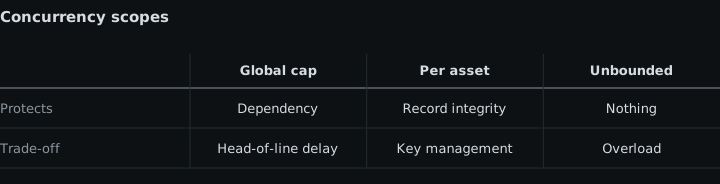
Configure the gate so that only one job for a given key may be active. The next job for that key remains queued until the active job completes, fails into its terminal path, or is otherwise resolved according to the retry policy. Per-key serialization prevents concurrent work for one asset while allowing unrelated assets to proceed in parallel.
Preserve ordering when an earlier update changes what a later update means. Do not let a failed older job sit outside the keyed lane while a newer update overtakes it. If only the newest desired state matters, coalescing queued work can be valid, but make that an explicit rule and retain enough information to explain which events were superseded. It is the wrong choice when every transition must reach the destination.
A busy key can still develop its own backlog. That is the intended trade: one asset waits while other keys continue. If unrelated assets also stop, the implementation is acting as a global lock rather than a keyed one.
-
Add a separate cap for shared dependencies.
Per-key control protects each record, but a burst involving thousands of different keys can still send thousands of requests to the same API, database, or transformation service. Apply a global concurrency cap at the point where jobs begin using that shared dependency. Set it from observed successful capacity and throttling behavior; no supported numeric threshold is supplied here, so choosing a universal slot count would be guesswork.
Cloudflare’s queue backpressure guidance, accessed August 26, 2026, describes the central trade: limiting consumer concurrency can protect an upstream system, but the queue grows and overall latency rises when arrivals outpace completions. Monitor the dependency while adjusting the cap instead of treating the initial value as permanent.
A global concurrency cap protects shared dependencies but can create head-of-line blocking when one slow class occupies every slot. If slow video work and short metadata updates use the same slots, for example, the short class can wait even though it is unrelated to the slow jobs. When classes have materially different dependencies or duration, put them in separate lanes with separate caps. The cost is more queues, routing rules, dashboards, and failure paths. Do not split classes merely to make the diagram tidy.
-
Make retries obey both controls.
A retry is still work against the same target and dependency. Return it to the same key lane and count the active attempt against the global cap. Immediate retries during dependency throttling consume capacity that could otherwise drain healthy work, so delay retryable attempts and limit how many times they can return. Send exhausted or non-retryable work to a review path rather than letting it cycle forever.
Make destination writes safe to repeat by carrying a stable event identifier or desired-state version where the destination supports one. Record the attempt number and final disposition. The detailed choices—retryable errors, delay, exhaustion, and notification—belong in the flow error-handling policy; concurrency control should enforce that policy, not create a second one.
-
Test collisions, parallelism, and overload separately.
Run three burst tests before enabling the flow. First, submit several events for one key and verify that no two mutable sections overlap. Second, submit events for different keys and verify that they can proceed concurrently. Third, submit more distinct-key work than the global cap permits and verify that active work stops at the cap while excess events remain queued.
In the execution and queue logs, retain the key, event identifier, arrival time, start time, completion time, attempt count, dependency class, and outcome. Watch active concurrency, queued work, age of the oldest queued event, completion rate, throttling responses, and failed work. A growing oldest-event age shows that the system is not catching up even if executions continue to succeed.
Finally, interrupt or slow one workload class during a test. Confirm that it cannot take every lane intended for unrelated work, and confirm that a failed keyed job follows the chosen ordering rule. Use a scheduled reconciliation flow to compare destination state with the authoritative source after overload or manual intervention; reconciliation is a repair path, not a substitute for controlling concurrent writes.
Expected result
The finished automation admits no more work than its shared dependencies are configured to handle, runs at most one mutable job for each asset or external record, and continues processing unrelated keys in parallel. Bursts appear as measurable queued work. Slow classes cannot silently occupy capacity reserved for other classes, and failed or superseded events have a recorded terminal outcome or reconciliation path.
Sources
- PowerFlow build guidecloudinary.com
- Amazon Builders' Library treatment of queue backlogsaws.amazon.com
- Cloudflare's queue backpressure guidancedevelopers.cloudflare.com
See also
Choose the right Power Platform binding for connector credentials, target configuration, automated imports, and secrets.
Choose fixed crops for consistent compositions; use content-aware gravity with a manual override when a varied library needs adaptive framing.
How a design-tool plugin keeps a media library as source of record: live placement, publishing back, source vs rendition, who owns latest, who approves.
Limit payloads at every block, keep personal data out of logs, and record exactly what external analysis services receive.