Hand Over a No-Code Automation Safely
- Author
 Joseph TrasattiMember of technical staff
- Published
- Section
- No-Code
- Length
- 7 min read3 sources cited
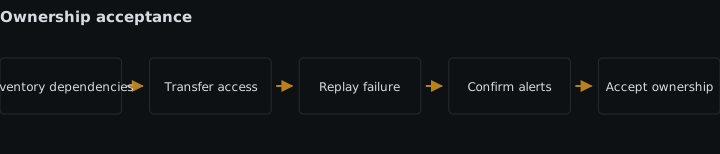
Transfer the flow only after the receiving team owns its credentials, alerts, rate-limit decisions, vendor contacts, recovery runbook, and escalation route. Name one service owner, move access into team-controlled systems, then have the new operators replay a representative failure and recover it before they accept production responsibility.
Prerequisites
Before the handover starts, identify someone from the current team who can explain the running automation and someone from the receiving team who can become its service owner. Both teams need access to the flow, its execution history, the connected systems, and a safe place or test case in which to trigger a failure.
Do not schedule the final transfer until the receiving team has time to operate the flow, not merely inspect its canvas. If nobody can obtain the required logs, credentials, alert settings, or recovery access, the automation is not ready to change hands.
Handover steps
-
Record the production boundary before changing access
Start with the trigger and follow one representative execution to its final side effects. Record what starts the flow, what data enters it, which blocks call external systems, what it creates or changes, and where an operator can see the result. Include scheduled jobs, webhooks, manual triggers, retries, and error branches that are actually present.
Mark every dependency outside the visual canvas: secret stores, vendor consoles, notification channels, storage locations, API endpoints, approval queues, and downstream services. The mechanism matters because a block that looks self-contained may rely on a credential or webhook configured elsewhere. Canvas edit permission proves only that someone can change the diagram; it does not prove that they can operate the production system.
Capture the current flow definition before editing it. If the platform supports export or copying, follow the controls described in importing and exporting no-code flow definitions safely. Record which version is running and how to return to it. A screenshot is useful for orientation but is not a recoverable definition.
-
Name the service owner and escalation route
Assign one named service owner from the receiving team. Record where alerts go, who responds first, who can make a disable-or-continue decision, and where that person escalates when the failure crosses a team or vendor boundary. Include the current owner, the receiving manager or on-call route, relevant dependency owners, and the vendor support contact available under the organization’s agreement.
A team channel can carry messages, but it cannot be accountable for deciding whether to stop processing, replay work, or call a vendor. A named service owner and escalation route prevent a shared visual flow from becoming an ownerless production system. The owner does not need to fix every dependency personally; the role is to make sure the response has a decision-maker and a next destination.
Do not accept a document that says only to contact the platform team or ask in chat. Test each route by confirming that the named destination exists, the receiving team can use it, and the person or rotation understands why the automation may contact them.
-
Move credentials into receiving-team control
Inventory every API key, OAuth connection, webhook secret, service identity, and emergency credential used by the flow. For each one, record its purpose, storage location, scope, rotation method, expiry if one exists, and the contact responsible for it. Do not put secret values in the handover document.
Issue or connect credentials controlled by the receiving team, update the flow, exercise the affected path, and then revoke credentials that belonged only to the departing owner. Sending an existing key through chat leaves the old ownership and recovery problem intact. The OWASP Secrets Management Cheat Sheet, accessed 2026-08-26, calls for rotation and revocation controls, contact metadata, tested restore procedures, and tested break-glass credentials.
This work costs more time than granting canvas access because each connected system may have a separate administrator. That cost is part of the transfer. If the receiving team cannot rotate or revoke a production credential without the previous owner, ownership has not moved.
-
Transfer alerts, rate-limit decisions, and vendor access
Route success and failure notifications to destinations the receiving team monitors. Confirm that an alert contains enough context to find the failed execution, and document which failures stop the flow versus follow a recoverable error path. Do not assume notification settings travel with a copied flow.
Cloudinary’s MediaFlows flow-building documentation, accessed 2026-08-26, says that a shared flow creates an independent imported copy and that its notification configuration starts empty. It also distinguishes runtime, timeout, and general errors, with flow-level notifications needed for unrecoverable failures. For a Cloudinary MediaFlows handover, recreate and test notifications in the receiving product environment rather than treating the share link as the transfer itself.
Record every downstream rate limit that operators must watch, where usage or rejection appears, and the agreed response: slow intake, queue work, retry later, disable the trigger, or escalate. Use handling downstream rate limits in no-code automations when the flow needs an explicit backoff or queueing design. Do not invent a numeric threshold; copy only a limit verified in the vendor’s current documentation or the organization’s contract, with its check date.
Finally, verify that the receiving team can open vendor support requests and supply the identifiers support will request. A vendor contact belonging only to the previous team is another unresolved dependency, even when the flow continues to run.
-
Write recovery procedures around observable failures
Turn the dependency inventory into a short runbook. For each material failure mode, state what the operator sees, where to inspect logs, what work may be incomplete, how to stop further processing, how to restore service, how to replay or reconcile affected items, and when to escalate. Include the rollback or restore path captured in step one.
Separate safe recovery actions from actions that can duplicate, delete, publish, or charge for work. If an operator cannot tell whether a retry is safe, the runbook must say to stop and escalate. When error handling has outgrown what the canvas makes reviewable, assess when a no-code automation should become code instead of hiding more operational state in blocks.
The runbook is wrong if it assumes the original builder will be available. That person may remain an escalation contact during the transition, but the first response and ordinary recovery path must work without them.
-
Have the receiving team replay a representative failure
Before accepting the handover, the receiving team must trigger and recover from a representative failure using the real alert, logs, credentials, runbook, and escalation route. Choose a failure that exercises the flow’s important operational boundary, such as a rejected downstream request or unavailable dependency. Use a test environment or bounded test input so the exercise does not create unintended production side effects.
The current owner should observe rather than drive. The receiving operator should identify the failed execution, explain its effect, take the documented containment action, invoke the escalation route if required, restore the path, and verify the final outcome. Record gaps as handover defects and repeat the exercise after fixing them.
Google’s SRE guidance on accelerating engineers to on-call, accessed 2026-08-26, recommends contained but realistic breakages with real monitoring and tooling before someone takes production responsibility. Reading a runbook checks recognition; replaying a failure checks whether access, alerts, diagnosis, and recovery work together.
Do not waive the exercise because the flow is visually simple. The receiving team should refuse acceptance if alerts do not arrive, logs are inaccessible, credentials still depend on the previous owner, recovery creates an unexplained result, or escalation reaches nobody.
-
Sign off ownership and remove the old operating path
Record the acceptance date, named service owner, first-response destination, escalation route, current flow version, credential owners, alert destinations, verified rate-limit references, vendor contact, recovery runbook, and the completed failure exercise. Both teams should agree on any remaining work and who owns it.
After the replacement access and recovery path have been tested, remove permissions and credentials that existed only for the former owner. Leaving them indefinitely preserves two operating paths and makes later auditing harder. If temporary overlap is required, give it an explicit end condition and owner.
Expected result
The receiving team can change, observe, stop, restore, and escalate the automation without relying on its original builder. Credentials, alerts, rate limits, vendor contacts, and recovery procedures have accountable owners; one named service owner holds the production decision; and a representative failure has been detected and recovered by the team accepting responsibility.
Sources
- OWASP Secrets Management Cheat Sheetcheatsheetseries.owasp.org
- MediaFlows flow-building documentationcloudinary.com
- SRE guidance on accelerating engineers to on-callsre.google
See also
How a media library app integration inside a headless CMS stores references, defers transformation to delivery, scopes folders, and lives or dies on metadata.
Configure no-code HTTP requests with stored secrets, explicit success rules, schema checks, and retries that cannot repeat side effects.
Prevent duplicate API side effects by binding retries to one operation key, retaining outcomes, and treating timeouts as unknown results.
Export a secret-free flow definition, map destination dependencies before enablement, and test the import with fixed fixtures.