Call External APIs from No-Code HTTP Blocks
- Author
 Joseph TrasattiMember of technical staff
- Published
- Section
- No-Code
- Length
- 13 min read3 sources cited
Configure the request from the downstream API’s contract: keep credentials in stored secrets, send the documented method and payload, accept only approved status codes and response shapes, and set timeout, retry, and idempotency rules according to whether repeating the operation can create additional side effects.
Prerequisites
Obtain the downstream API’s current contract before opening the flow builder. You need its endpoint, method, authentication scheme, request fields, successful status codes, response schema, timeout guidance, retry guidance, and documented idempotency mechanism, if any. If the vendor does not define the success response or the effect of repeating a request, the HTTP block cannot make that ambiguity safe.
You also need a non-production endpoint or test record that can be created, changed, and removed without harming live data. If the surrounding automation is not built yet, establish its trigger and inputs first using the process for building a media automation flow from blocks. The HTTP call should receive a deliberate, bounded input rather than the entire output of whichever block happens to precede it.
Steps
-
Write the request contract before configuring the block
Reduce the vendor documentation to a short contract beside the flow:
- one endpoint and HTTP method;
- the headers and request media type;
- the smallest request body the operation needs;
- the allowed successful status range or explicit status-code set;
- the required response fields, their types, and whether a body may be empty;
- the maximum time the flow will wait;
- which failures may be retried;
- whether a repeated request can repeat a side effect.
Do not start from “send this JSON and continue if the request completes.” A completed network request proves only that an exchange ended. The downstream application can still reject authentication, reject the payload, accept work for later processing, or return a shape that the next block cannot use.
Make the contract narrow enough to test. If the API documents
200with a JSON object containing an identifier, require that. If it documents201for creation, allow that code. If it can return either, record both. Do not widen the rule merely because another2xxresponse looks close enough.The cost of a narrow contract is maintenance when the vendor changes its API. That is preferable to silently routing a changed response into blocks built for the old shape. If the vendor offers a dedicated integration block whose contract is already represented by typed fields and outputs, use that instead of a generic HTTP block unless you need behavior the dedicated block omits.
-
Choose the method from the operation’s side effects
Use the method documented by the downstream API; do not substitute
GET,POST,PUT, orDELETEbecause one is easier to configure. RFC 9110’s HTTP method and status semantics distinguish safe methods from methods that change state and define idempotency in terms of the intended effect of sending the same request more than once.That distinction controls the later retry decision. A read using
GETdoes not ask the server to create or change a resource. A correctly implementedPUTorDELETEhas idempotent method semantics: repeating the same request is intended to leave the resource in the same final state, although individual responses may differ. APOSTthat creates an order, job, message, or asset can create another one when repeated unless that particular API documents protection against duplication.Treat the API’s contract, not the method name alone, as decisive. If a vendor uses
POSTfor a repeat-safe operation and documents an idempotency key, record the header name, key scope, and reuse rules. If it does not document such a mechanism, do not invent a header and assume the server honors it.The wrong method can turn a retry into another side effect. Conversely, forcing every state change through a non-retried request avoids duplication but gives up automatic recovery from ambiguous network failures. Make that trade before wiring the block.
-
Add the generic HTTP request block and map only required inputs
Add the builder’s generic request block after the block that produces its input. In Cloudinary MediaFlows, the Send HTTP Request block reference checked on 2026-08-18 documents a required target URL plus fields for the method, JSON-formatted headers, an optional body, a form-body toggle for
application/x-www-form-urlencoded, and an optional JQ response filter. It positions the block as the generic route to third-party APIs when a dedicated integration block is unavailable.Set the endpoint as a fixed base URL where possible. Insert only the path values and non-sensitive query values the request needs. Map the method from the written contract rather than from a runtime value; allowing upstream data to choose the method makes the flow harder to review and can change a read into a write.
Construct the body explicitly. Do not forward a complete trigger payload just because the block accepts JSON. An explicit body makes field names, null handling, and data disclosure visible on the canvas. It also prevents an upstream block from adding fields to an external request without anyone editing the HTTP block.
This takes more setup than passing one large object. It is the wrong approach only when the downstream contract explicitly requires that complete object and the flow has already bounded and validated it. For a focused treatment of reducing what crosses block boundaries, apply data minimization across no-code flows.
-
Put authentication in headers backed by stored secrets
Create the credential in the platform’s secret store, then insert the secret reference into the required authentication header. Do not paste a token into the block, a flow variable, a test payload, or a copied URL. Cloudinary’s PowerFlow building documentation, last updated 2026-08-18, says block fields can use flow secrets and that secrets can be established while a flow is still a draft.
Keep the header structure visible but the value secret. For example, the canvas may show that an
Authorizationheader exists while its value comes from a stored secret. The reviewer can then verify the authentication mechanism without reading the credential.Avoid sensitive query parameters. URLs are widely logged, so a key placed after
?can travel through records that are handled differently from secret values. If an API accepts a credential in either a header or the query string, choose the header. If it requires form-encoded credentials, send them in the request body only when that placement is part of the documented authentication exchange; the MediaFlows block has a form-body option for that case.If the only supported scheme requires a long-lived secret in the URL, the generic block is the wrong boundary. Put a controlled proxy in front of the API so the flow calls the proxy with header authentication and the proxy contains the vendor-specific exchange. That adds a service to operate, but it keeps the sensitive value out of the configured URL. Use the full secret-management procedure for no-code flows when setting access, rotation, and environment separation.
-
Encode the request body and headers exactly once
Set the request media type the API documents and encode the body to match it. For JSON, keep values as their real JSON types: numbers as numbers, booleans as booleans, arrays as arrays, and absent optional values absent rather than empty strings. For form-encoded requests in MediaFlows, set
Content-Typetoapplication/x-www-form-urlencoded, place the fields in the request body, and enable the option that sends form data in the body instead of appending it to the URL.Do not encode an object into a JSON string and then place that string inside another JSON object unless the API explicitly calls for nested encoded text. That produces a valid outer payload with the wrong inner type. It can pass a visual inspection while failing the downstream schema.
Decide which upstream values are allowed before interpolation. A value that becomes a path segment, header, or body field should have one defined source and one expected type. If a required value can be missing, branch before the HTTP block and handle that condition locally instead of sending a knowingly incomplete request.
Explicit encoding costs a few more mapping fields. It is still the better choice for an external contract. A generic pass-through is appropriate only when preserving the original payload byte-for-byte is itself the documented requirement.
-
Define success with both status and schema
The block must define success by an allowed status range or explicit set and the expected response schema, not by any completed network request. These checks answer different questions: the status says how the server classified the result; the schema says whether the response contains the data the remaining flow is built to consume.
Start with the API’s documented statuses. Do not automatically accept every
2xxresponse. Under RFC 9110,202 Acceptedmeans the request was accepted for processing, not that processing finished. Route it to polling or webhook handling if the operation is asynchronous.204 No Contentcannot satisfy a contract that requires a response object. A creation flow expecting201and an identifier should not treat an empty200as equivalent unless the vendor documents both forms.Then validate the response media type and body shape. At minimum, check every field used later for presence and type. Add enum, array, or nested-object checks only where the vendor contract defines them. A response filter that extracts a smaller JSON object is useful for limiting downstream data, but extraction is not a substitute for validation: a filter can produce an empty or partial result that still lacks the required contract.
If the builder cannot inspect the status or validate the necessary schema, do not label the block successful based on transport completion. Add condition blocks where the response is exposed, or place a small validating proxy between the flow and the API. The proxy costs engineering and another network hop; it is the correct boundary when an invalid response could trigger a destructive or externally visible next step.
-
Set the timeout from the downstream operation, not the largest available value
Choose a timeout that allows the documented operation to finish while leaving time for error handling and the remaining blocks. The timeout is a failure boundary, not a speed setting. Making it longer occupies the flow for longer; making it shorter creates more ambiguous outcomes in which the caller stops waiting while the server may continue working.
The dated MediaFlows documentation says an entire flow times out after more than five minutes and gives multiple HTTP requests to slow services as an example. The cited Send HTTP Request block reference does not document per-block timeout controls. If the builder exposes no suitable per-request control, compare its fixed behavior with the downstream operation before enabling the flow. Do not assume an undocumented value.
A synchronous HTTP block is the wrong mechanism when the downstream service normally completes outside the available flow budget. Submit the job, validate the acceptance response, retain its identifier, and resume from the service’s documented completion signal. That may mean a webhook-triggered flow or a bounded status check rather than holding one execution open.
For a read with no side effect, a timeout primarily withholds data from later blocks. For a write, it is also an ambiguity: the operation may have committed even though no response arrived. That difference must feed directly into the retry policy.
-
Make retries conditional on repeat safety
Configure retries only for failures the downstream documentation classifies as temporary, and only when repeating the exact operation is safe. Do not retry schema failures, authentication failures, or other responses that require a changed request. Sending the same invalid input again adds delay without changing the condition.
Use three cases:
Downstream operation Retry condition Required protection Read with no state change Documented temporary failure or ambiguous transport failure A bounded attempt count and timeout budget Idempotent state replacement or deletion Same, provided the API follows its documented method semantics The same target and request content Non-idempotent creation or action Only when the API documents duplicate protection The same documented idempotency key for every attempt Generate an idempotency key once per logical operation, before the HTTP block, and reuse it across all attempts. Generating a fresh key inside each retry makes every attempt look new. Reusing one key for unrelated operations creates the opposite error, causing separate work to be treated as a duplicate if the service scopes keys that way. Follow the downstream API’s documented key lifetime and scope; if those are absent, the protection is unverified.
If the no-code block retries automatically but does not expose which failures it retries, it is the wrong choice for an unprotected side effect. Disable retries if possible, call through a proxy that owns the policy, or require reconciliation before another attempt.
-
Route contract failures away from side-effecting blocks
Connect the success path only after status and schema acceptance. Send transport errors, disallowed statuses, malformed responses, and missing fields to an error path that records enough context to identify the operation without recording credentials or the complete sensitive payload.
MediaFlows distinguishes recoverable block errors from unrecoverable configuration errors. Its documentation gives a
400API response as an example that can follow an error path, while an unresolved input variable stops the flow. It also documents flow notifications and lets an error-path block reference the failing block’s error. Use those facilities to separate “the downstream rejected this request” from “the flow could not construct a request.”Do not put the same write block on both the success and error paths as a convenience. An error handler should notify, log a bounded diagnostic record, quarantine the item, or start an explicitly safe recovery path. It should not guess that repeating the operation will help.
Add an execution-level alert for failures that stop before the error path. If the external endpoint later reports completion through a webhook, treat delivery monitoring as a separate concern and follow the method for monitoring webhook delivery from no-code workflows.
-
Test the contract and the ambiguous cases before enabling the flow
Run the flow with one known-valid request and confirm the exact status, response shape, and downstream state. Then exercise the boundaries deliberately: a rejected credential, a missing required input, a documented non-success status, a success status with an invalid body, a delayed response, and a repeated logical operation using the same idempotency key where the API documents that mechanism.
Inspect the execution path, not just the final flow status. Confirm that only the valid response reaches later blocks, every rejected response reaches the intended error handling, and logs contain no authentication value or sensitive query parameter. For an operation with a side effect, inspect the downstream system after the timeout and retry tests to determine whether one logical operation produced one effect.
If a test cannot establish whether the first timed-out request took effect, do not enable automatic retry. Add a lookup or reconciliation step using a stable operation identifier, or leave the item for explicit review. That costs handling time, but it avoids converting uncertainty into a duplicate write.
Expected result
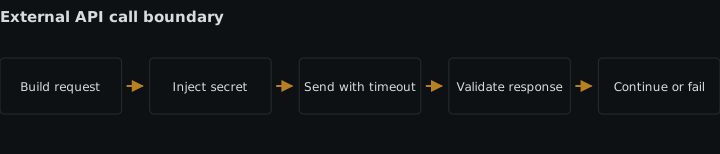
The enabled flow sends the documented method, headers, and minimum payload; authentication values come from stored secrets and do not appear in sensitive query parameters. Only responses within the allowed status policy and matching the required schema enter the success path. Timeouts and retry attempts stay within the flow budget, and a repeated request cannot repeat an unprotected downstream side effect.
Sources
- RFC 9110’s HTTP method and status semanticsrfc-editor.org
- Send HTTP Request block referencecloudinary.com
- PowerFlow building documentationcloudinary.com
See also
Prevent duplicate API side effects by binding retries to one operation key, retaining outcomes, and treating timeouts as unknown results.
Export a secret-free flow definition, map destination dependencies before enablement, and test the import with fixed fixtures.
Choose where no-code media processing belongs: before storage or before first delivery, without losing originals or doing the same work twice.
Build an asset loop from a fixed snapshot, preserve per-item outcomes, and cap concurrency so downstream APIs stay within their limits.