Idempotency Keys for No-Code API Actions
- Author
 Joseph TrasattiMember of technical staff
- Published
- Section
- No-Code
- Length
- 12 min read3 sources cited
Give each business operation one stable idempotency key, persist the key, exact request, and outcome through the whole retry and replay window, and reuse them only for unchanged retries. Treat timeouts as unknown outcomes, not failures; reconcile before issuing a changed request or a new key.
Prerequisites
Before changing the automation, identify:
- the action that creates or changes remote state;
- the trigger field that uniquely identifies one business operation;
- every path that can retry or replay the action, including manual reruns;
- the longest interval during which any of those paths can run again;
- the provider’s idempotency field, retention period, and parameter-matching rules;
- storage that the automation can read and write before calling the API.
Do not infer safety from the HTTP verb alone. RFC 9110’s definition of idempotent methods says that repeating an idempotent method has the same intended server effect as sending it once. It identifies PUT, DELETE, and safe methods as idempotent, but says a client should not automatically retry a non-idempotent method unless it knows the request semantics are idempotent or can detect that the original request was never applied. A provider-specific key is the contract that can make a state-changing POST retryable.
If the no-code tool cannot place the provider’s required key in a header or request field, persist state before the call, or branch on an ambiguous result, its standard connector is the wrong component. Use an HTTP request block that exposes the request details or put a small controlled endpoint between the automation and the provider.
Bind the key to the business operation
-
Read the provider’s idempotency contract before building the retry path.
Confirm which operations accept a key, where the key belongs, how long the provider remembers it, whether changed parameters are rejected, and which result is returned for a duplicate request. Record the answers beside the automation rather than relying on the connector’s label.
Provider behavior matters. In Stripe’s idempotent-request documentation, checked 2026-08-26, Stripe says it saves the status code and response body from the first request associated with a key, including a
500response. It also says keys can be removed after they are at least 24 hours old; a key used after pruning starts a new request. Stripe compares the new parameters with the original parameters and reports an error when they differ.That example is not a universal default. If another provider does not document retention or parameter comparison, mark those properties unverified. Do not silently substitute Stripe’s behavior.
This step costs review time and may force replacement of a convenient native connector with a configurable HTTP block. Skipping it is only reasonable when the action has no remote side effect. A read-only lookup does not need a duplicate-prevention ledger merely because the automation platform offers one.
-
Name the business operation independently of the HTTP request.
Write one sentence that describes what must happen once. Examples of the form are “create the refund requested by trigger event E” or “publish the asset version approved by event E.” The operation is not “run step 12” and not “send a POST,” because a rerun can change step numbers while still representing the same intent.
Prefer an immutable trigger-event ID when one event corresponds to exactly one remote action. If one event can legitimately produce several actions, add the action identity: for example, an event ID plus an operation name and item identity. If the trigger has no stable ID, create an operation ID at intake and persist it before any state-changing request.
AWS’s account of safe retries with idempotent APIs explains why a caller-provided request identifier is stronger than guessing from matching parameters. Two identical-looking requests can express two genuine intentions. Conversely, one intention can be delivered more than once because a response was lost. The identifier carries the caller’s intent through those cases.
Do not use a payload hash as the sole business identity. It collapses two intentional operations with identical fields into one. A hash can help detect that a retry’s parameters changed, but it cannot decide whether two matching payloads represent the same operation.
The cost of a durable operation ID is a stored field and a rule for its scope. It is the wrong key source when the chosen trigger value can be edited, recycled, or shared by several distinct actions.
-
Derive one stable key and store it before the first attempt.
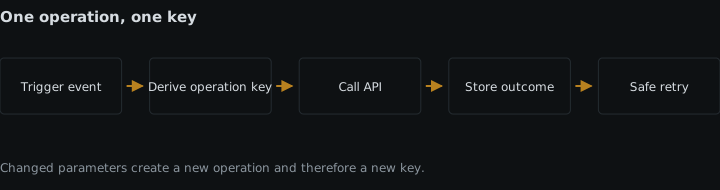
Derive one stable idempotency key from the business operation or trigger event. The mapping must be deterministic, or the generated value must be written to durable storage before the request can run. Every execution path for that operation must recover the same stored key.
Keep the key opaque and free of customer data. A readable prefix for the action can help operators, but uniqueness must come from the operation identity rather than a timestamp generated at the HTTP step. A timestamp, run ID, or random value created on every attempt gives each retry a new identity and therefore permits another side effect.
Store at least the operation ID, provider, remote action, idempotency key, and creation time. Put a uniqueness rule on the operation identity if the storage layer supports one. Without such a rule, two concurrent automation runs can both observe “no record,” create different keys, and call the provider.
The storage write adds latency and another failure point. That is the necessary cost of carrying intent across retries and manual replays. Generating a fresh key inside a connector is acceptable only when that connector also persists and reuses it across every retry path; otherwise it is the wrong place to generate the key.
-
Freeze the request represented by the key.
Build the complete request once, then save the exact values that will be sent: method, endpoint identity, relevant headers, query fields, and body. Reuse the key only for byte-equivalent retries of that action.
“Same operation” is not permission to rebuild a slightly different request. A later lookup might return a changed email address, price, file URL, metadata value, or ordering. A template might insert the current time. A connector might omit an empty field on one run and send it on another. Any of those changes means the retry is no longer byte-equivalent.
The simplest no-code implementation is to assemble the payload before the HTTP step and persist that snapshot with the key. The retry branch reads the snapshot; it does not re-read mutable source records. If retaining the full request is inappropriate, store the stable source fields needed to reproduce it plus a digest used to reject a mismatch. Do not put credentials in the snapshot.
Snapshotting costs storage and creates data-retention work. Reconstructing the request costs less storage but is the wrong answer when inputs can change or serialization is not stable. A digest alone is also insufficient when the system cannot reconstruct the original bytes.
-
Create the operation ledger before calling the provider.
Use a ledger record with states that distinguish “not attempted,” “in flight,” “confirmed,” “rejected,” and “unknown.” Save the key and frozen request before moving the record to
in_flight. After a response, save the outcome against the same record.Retain enough outcome data to decide what happened without repeating the mutation: the response class, provider object identifier when returned, attempt time, and whether the result is confirmed or ambiguous. The ledger is the automation’s memory; the provider’s idempotency store is the remote guard.
Write the ledger before the API action, not in the success branch after it. If the remote side effect succeeds and the workflow stops before that late write, the next run has no evidence that it must reuse the old key.
A ledger requires a datastore, access controls, cleanup, and a way to resolve concurrent writes. It is unnecessary for an operation whose provider retention is documented to exceed every possible retry and replay interval and whose key, request, and outcome already persist durably in the automation platform. It becomes necessary when any part of that guarantee is missing.
-
Send the stored key with the frozen request.
Configure the action to read both values from the ledger. Put the key in the exact header or field named by the provider, and send the saved request without enriching it again downstream.
Keep transport retries under the same operation record. A connector that invisibly generates a new key for each attempt defeats the design. A connector that retries with the same key but rebuilds a mutable payload is also unsafe because the provider may reject the mismatch or treat it according to undocumented behavior.
If the request receives a rate-limit response, schedule the later attempt without creating a new operation. The retry timing belongs in the downstream rate-limit handling path; the operation key and frozen request remain unchanged.
-
Classify the result before deciding to retry.
A clear success response moves the ledger to
confirmedand stores the remote identifier and outcome. A clear validation rejection moves it torejected; changing the request and sending it with the old key is not a retry.A timeout, connection reset, or lost response moves the operation to
unknown. Do not assume a timeout means the first request failed, because the remote side effect may already exist. The request can reach the provider and complete even when the response never reaches the automation.For an
unknownresult, follow this order:- Look for a stored response from another concurrent attempt.
- If the provider offers a lookup using the operation’s business reference or returned remote identifier, reconcile against it.
- If the provider’s idempotency contract still applies, retry the byte-equivalent request with the same key.
- If the contract has expired and reconciliation cannot prove the outcome, stop automatic mutation and send the ledger record for review.
Creating a new key immediately after a timeout is the wrong answer: it tells the provider that the second call is a new intention. Blindly marking the operation successful is also wrong because the first request might not have been applied. The honest state is
unknownuntil the provider, a safe retry, or reconciliation resolves it. -
Make every retry and replay recover the original record.
Route automatic retries, scheduled retries, error-handler reruns, and operator replays through the same lookup: business operation ID first, ledger record second, provider call last. A manual “rerun from failed step” control is not exempt.
Webhook delivery is a common source of a second execution path. Deduplicate the incoming event, then bind the downstream API key to the accepted operation. These are separate boundaries: webhook replay protection prevents repeated trigger processing, while the idempotency key prevents a repeated outbound action from creating another remote effect.
Reusing the stored request can make recovery less convenient because an operator cannot edit a field and press retry. That constraint is intentional. An edit creates a different request and must enter the changed-intent path rather than borrowing the identity of the failed attempt.
-
Retain the key and outcome for the full risk window.
Determine the maximum retry and replay window from the automation’s actual behavior: delayed retries, queued work, webhook redelivery, paused runs, and permitted manual replay. Persist the key and outcome for at least that entire window.
Compare that interval with the provider’s documented key retention. If the provider expires keys sooner, add an internal operation ledger that continues to recognize the operation after the remote key has expired. The ledger must block an automatic second mutation or require reconciliation; merely remembering the old key is insufficient once the provider can treat it as new.
Retention has concrete costs: records consume storage, outcome data needs access controls, and expired entries need deliberate cleanup. Keeping records indefinitely is not automatically better because it increases those costs and can make an old identifier collide with a future intention. Set deletion from the longest legitimate replay window, not from convenience or the provider’s shortest published period.
The wrong retention rule is “keep it until the workflow succeeds.” A delayed duplicate can arrive after success. Another wrong rule is “keep it as long as the provider does” when the automation permits a later replay.
-
Issue a new key only for changed intent.
Do not reuse a key after changing parameters. Close the old ledger record as rejected, unknown, or superseded, preserving its request and outcome. Create a new business operation, a new key, and a new frozen request for the changed action. Link the two records so an operator can see why another mutation was attempted.
This applies even to a one-field correction. Reusing the old key can produce a parameter-mismatch error where the provider checks requests, or undocumented behavior where it does not. A new key makes the changed intention explicit, but it also permits a new side effect. Therefore, do not create it merely to escape an unresolved timeout; resolve or review the original operation first.
The cost is an extra branch and an operator-visible distinction between retry and replacement. That distinction is wrong only when the changed fields are outside the provider request and do not alter the bytes sent. In that case, the outbound request remains the original retry.
- Test the failure paths, not just the successful run.
Use a non-production destination or an operation whose effects can be inspected safely. Verify these cases:
- two concurrent executions for one trigger recover one ledger record and one key;
- a retry sends the same stored request and key;
- a mutable source-field change does not alter an existing retry;
- a changed request is rejected locally from the old-key path;
- a timeout records
unknownrather thanfailed; - a replay inside the retention window returns the stored outcome or safely retries;
- a replay after provider expiry is stopped by the internal ledger;
- a genuinely new business operation with identical parameters receives a new key.
Inspect the ledger as well as the remote system. A green workflow run proves only that the automation reached its final block; it does not prove that two overlapping calls did not create two effects.
Failure testing costs setup time and may require a controllable proxy or manual interruption to produce an ambiguous response. If the environment cannot simulate a timeout, document that gap rather than claiming the branch has been tested.
Expected result
The finished automation assigns one durable key to one business operation, stores the exact request and outcome through the maximum retry and replay window, and routes every retry through that record. Unchanged retries reuse the original key and bytes. Changed parameters create a separate operation. Timeouts remain unknown until reconciliation or a same-key retry establishes the outcome, and provider-side key expiry cannot silently turn an old replay into a new mutation.
Sources
- RFC 9110’s definition of idempotent methodsrfc-editor.org
- Stripe’s idempotent-request documentationdocs.stripe.com
- AWS’s account of safe retries with idempotent APIsaws.amazon.com
See also
Export a secret-free flow definition, map destination dependencies before enablement, and test the import with fixed fixtures.
Choose where no-code media processing belongs: before storage or before first delivery, without losing originals or doing the same work twice.
Build an asset loop from a fixed snapshot, preserve per-item outcomes, and cap concurrency so downstream APIs stay within their limits.
How no-code builders upload and deliver media: pre-built integrations, plain transformation URLs, one shared credential, and where signed requests stop.