Use service-principal ownership for production flows
- Author
 Joseph TrasattiMember of technical staff
- Published
- Section
- No-Code
- Length
- 13 min read3 sources cited
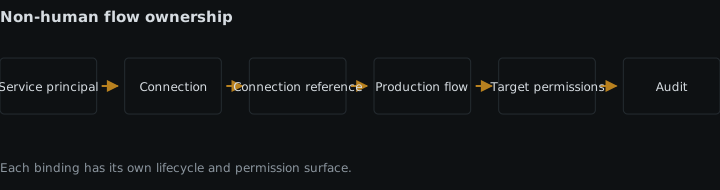
Use an organization-controlled non-human identity for production flow ownership when both the automation platform and its connectors support it. Then verify four independent bindings: flow owner, connection owner, connection reference, and target-system permissions. Apply least privilege, record rotation and emergency-transfer procedures, and alert before any credential expires.
Ownership is more than the flow record
Prerequisites
Before changing production ownership, collect:
- The production flow and every trigger, action, child flow, and connection it uses.
- The connection reference associated with each connection, where the platform uses references.
- The permissions granted in every target system.
- An organization-controlled non-human identity that the automation platform and the required connectors can use.
- Administrators who can manage that identity, the automation environment, its connections, and the target systems.
- A maintenance window in which the team can change the bindings, run the flow, and restore the previous configuration if validation fails.
Do not start by removing the employee owner. First prove that the service principal or equivalent non-human identity can occupy every required binding. A platform may support non-human flow ownership while an individual connector still requires an employee login. In that condition, the ownership migration is incomplete and must not be represented as staff-independent.
-
Confirm that a non-human identity is supported end to end.
Production ownership should use an organization-controlled non-human identity instead of an employee account wherever both the platform and the connector support it. The condition matters: flow-level support does not prove that every connection can authenticate as that identity.
For Power Automate, Microsoft documents that a service principal represented by an application user can own and run flows. Its service-principal-owned flow guidance, updated 15 August 2026, identifies mission-critical flows and flows deployed through development, test, and production pipelines as intended cases. The mechanism removes the employee lifecycle from the flow-owner binding: a resignation, role change, or removal of the employee’s licence no longer removes the named owner.
Check each connector separately. Record whether it accepts the service principal directly, accepts a connection shared with the service-principal application user, or requires an interactive employee identity. Also check the current licensing and request-limit treatment of a service-principal-owned flow; Microsoft’s documentation says that this differs from an ordinary licensed user, so employee licensing assumptions cannot simply be carried over.
Stop the migration if a required production connector cannot use the proposed identity. Changing only the displayed owner would leave an employee-owned credential in the execution path. The immediate cost of doing this check is administrative and test time. The alternative cost is discovering the unsupported connector only after the employee account has been disabled.
-
Create one production identity under organizational control.
Create or select the service principal, application user, or platform-equivalent identity for the production flow. The organization, rather than an individual maker, must control its lifecycle and recovery path. Give the identity a name that identifies the workload and production environment; do not reuse an employee’s personal identity under a generic display name.
Record who may administer the identity and who approves permission changes. Keep the administrator role separate from ordinary flow editing where the platform allows that separation. The non-human identity exists to make execution independent of staff turnover, not to give every maker permanent access to production credentials.
This identity has an operating cost even if creating it has no direct fee: someone must maintain its credentials, access policy, ownership records, and recovery procedure. It is the wrong answer when the platform or a required connector cannot authenticate it. In that case, document the employee dependency explicitly and treat replacing it as unfinished production work rather than hiding it behind a service-owned flow record.
-
Map the four bindings before changing any of them.
Build an inventory with one row per trigger or action that crosses a system boundary. For each row, identify four separate bindings:
Binding What it controls What must survive a staff change Flow owner Who owns and administers the automation record The flow remains owned by the organization-controlled identity Connection owner Whose stored authentication the connector uses The connection remains valid without the departing employee Connection reference Which environment-specific connection the flow selects The reference still resolves to the intended production connection Target-system permissions What the authenticated identity may do in the destination The identity retains only the operations required by the flow These are separate bindings. A successful change to one does not repair the other three. Changing the flow owner does not move a stored connection. Replacing a connection does not automatically prove that a solution’s connection reference points to it. A valid reference does not grant permission in SharePoint, Dataverse, a media service, or any other target system.
Record the current and proposed value for every binding. Include the flow action or trigger that depends on it and the person responsible for validating the target system. If a row has an unknown owner, reference, or permission set, resolve it before cutover. An unknown cell is an untested employee dependency.
-
Assign the service principal as the production flow owner.
Change the flow-owner binding only after the identity exists and the inventory is complete. In Power Automate, the documented procedure is to represent the Microsoft Entra service principal as a Power Platform application user and replace the owner on the flow’s details. Turn the flow on only after its connection requirements are satisfied.
Ownership gives the organization-controlled identity responsibility for the flow record. It does not prove that the flow can authenticate to any connector. Preserve the previous owner information in the change record so that an unsuccessful cutover can be diagnosed without guessing what changed.
For platforms without service-principal ownership, use the platform’s supported organization-controlled non-human identity if one exists. Do not treat a shared password for an ordinary employee-shaped account as equivalent merely because several people know it. If the platform exposes no supported non-human ownership model, record that limitation and keep the employee dependency visible.
-
Replace or share each connection deliberately.
Inspect every connection from the inventory. Where the connector supports direct non-human authentication, create or select a production connection owned by the organization-controlled identity. Where the platform instead supports sharing an existing connection with the service principal, verify that sharing is supported for that connector and grant only the required use permission.
Microsoft’s connection-management documentation, updated 19 August 2026, describes a connection as the configured route through which a flow accesses data. It also documents connection details that show which apps and flows use a connection. Use that dependency view before replacing, updating, or retiring anything: one connection may serve more than the flow being migrated.
A connection can remain employee-owned even after the flow owner changes. That is why the connection owner must be recorded independently. Test the actual authentication path; a successful sign-in to the flow designer proves only that the administrator can edit the flow.
Do not delete the old connection during this step. First update references, validate execution, and identify every other flow that uses it. Deleting it early can break workloads outside the migration’s scope. If a connector requires an employee connection, mark that row as an exception with a named owner and remediation condition. The flow is not fully insulated from staff changes while that exception remains.
-
Bind every production connection reference to the intended connection.
In solution-aware platforms, the flow may bind to a connection reference rather than directly to a connection. A reference is an environment-level indirection: the flow selects the reference, and the reference selects a concrete connection. That separation permits the same flow definition to use different connections in development and production, but it also creates another binding that can be stale or wrong.
Microsoft’s connection-reference guidance, updated 9 January 2026 states that solution-aware flows bind operations to connection references and that a target connection is supplied for those references during solution import. It also says that the user enabling a flow must own or have permission to use all of its connections.
Open each production reference and verify its connector and selected connection against the inventory. Give references distinct workload and environment names so reviewers can tell which production connection they are meant to select. If the flow was added to a solution after being created outside one, confirm that it has actually been converted to use connection references; Microsoft documents that this conversion is not automatic in every case.
Do not put credentials or endpoint values into a connection reference merely to make deployment look uniform. A connection reference chooses a connection; an environment variable supplies configuration. Use the separate treatment of connection references versus environment variables when deciding where each deployment value belongs.
The cost of reference indirection is another component to name, deploy, validate, and repair. It is the wrong mechanism for values that are not connections. Its benefit appears only when the team validates the complete chain rather than assuming the reference itself contains working authentication.
-
Grant least privilege in every target system.
Configure the non-human identity in each target system for only the actions present in the production flow. Start from the inventory: a read action needs the relevant read permission; an update action needs the relevant update permission; an action that never deletes data does not justify delete permission.
Perform this step in the target system, not only in the automation platform. The connection can authenticate successfully while the target rejects an operation, or it can authenticate with permissions far broader than the flow requires. Both are defects: one stops the run, while the other increases what a compromised credential or mistaken flow edit could change.
Record the granted role or permissions beside the flow action that requires them and name the approver. If the connector hides the exact permissions requested during authentication, document that uncertainty rather than claiming least privilege has been proven.
Least privilege costs review time and may require a target-system administrator during initial setup and later changes. It is still the production default. A broad administrator grant is not an acceptable shortcut for avoiding permission analysis. If a new flow action later needs more access, make that increase a reviewed target-system change rather than silently broadening the identity in advance.
-
Move credentials out of employee custody and document their handling.
Identify every credential, certificate, token, or other authentication material on which the non-human connection depends. Store and administer it through the organization’s approved mechanism, with access limited to the people who maintain or recover the flow. Do not paste reusable production credentials into flow descriptions, comments, environment variables, tickets, or handover documents.
The runbook should name the credential without reproducing its secret value. Record where authorized administrators manage it, which identity and connections depend on it, who may rotate it, who approves an emergency replacement, and how to prove the new credential works. The broader rules for managing secrets inside no-code automation flows apply independently of flow ownership.
This step does not assume that every connector exposes a rotatable secret. Some connections may be renewed through an interactive authorization process. Record the actual supported mechanism for each connection. If the mechanism still requires a specific employee to sign in, the connection retains a staff dependency even though the flow has a service-principal owner.
-
Validate the complete chain before retiring the employee bindings.
Run the production flow through every material trigger and action path represented in the inventory. Check four things separately: the service principal owns the flow, each action selects the intended connection reference, each reference resolves to the intended connection, and the target system accepts the required operation with the assigned permissions.
A green flow status alone is insufficient if the tested path skipped a connector. Use controlled inputs that exercise each external binding without introducing unrelated production changes. Record the run, the paths exercised, and the resulting target-system state. Where an operation cannot be exercised safely during cutover, leave that binding marked unverified and arrange a bounded test; do not infer it from a different action using the same connector.
After validation, remove the departed or departing employee from the production ownership and connection path according to the platform’s supported procedure. Re-run the checks from an administrator context that does not rely on that employee’s session. If the flow stops working, restore the last valid binding and diagnose the specific layer rather than adding the employee back everywhere.
-
Write the rotation and emergency-transfer procedures.
Document credential rotation before the first rotation is due. The procedure must identify the affected identity, connections, references, flows, and target permissions; the authorized operator; the validation run; and the evidence that closes the change. Do not write only “rotate the secret.” The operator needs to know which bindings may need repair and how to distinguish an authentication failure from a reference or target-permission failure.
Write a separate emergency ownership-transfer procedure for loss of the non-human identity, administrative access, or a critical connection. It must name who can authorize the transfer, who can administer the automation environment and target systems, where the four-binding inventory is kept, and how execution is validated after the transfer. Keep it usable without help from the person who originally built the flow.
This is operational work, not documentation for its own sake. Without it, the organization has replaced one undocumented owner with another undocumented dependency. The detailed handover procedure for no-code automation ownership can carry the team, escalation, and acceptance records; this runbook must still contain the workload-specific bindings.
- Monitor expiration and binding health before a critical run.
Monitor the non-human credential, each connection, each connection reference, and the flow’s run results. Alert before any known credential or authorization expiration. Choose and record a lead time that gives the responsible team enough time to rotate and validate under its own change process; no universal number is supplied by the cited material, so do not invent one.
Route the alert to an organization-controlled queue or on-call path, not solely to the original maker. Include the affected flow, identity, connection, expiration time when the platform exposes it, runbook location, and responsible team. A dormant flow may not produce a failed run before its next critical schedule, so failure-only monitoring cannot satisfy the expiration requirement.
Add an ownership review after staff changes and after changes to connectors, credentials, solution imports, or target-system roles. The review repeats the four-binding check rather than looking only at the owner displayed on the flow. Connect these checks to the flow’s wider operational observability so authentication failures reach the same response process as other production failures.
Monitoring has a maintenance cost: alerts need an owner, a response procedure, and periodic tests. It is still cheaper in operational attention than letting a dormant flow discover an expired credential during a critical run.
Expected result
The production flow is owned by an organization-controlled non-human identity supported by the platform and every required connector. Its flow owner, connection owners, connection references, and target-system permissions are recorded and independently valid without an employee account. The identity has only the permissions required by the flow. Credential rotation and emergency ownership transfer are documented, assigned, and testable. Expiration monitoring alerts the responsible team early enough to rotate and validate credentials before a scheduled or event-driven production run depends on them.
Sources
- service-principal-owned flow guidance, updated 15 August 2026learn.microsoft.com
- connection-management documentation, updated 19 August 2026learn.microsoft.com
- connection-reference guidance, updated 9 January 2026learn.microsoft.com
See also
Choose signed or unsigned Cloudinary upload presets by client path, parameter control, and the guardrails a public no-code flow can enforce.
How strict transformation allowlists block unknown no-code delivery variants, preserve approved ones, and change the release process.
How to test a media automation safely: a separate product environment, a representative asset set, and failure branches broken on purpose before it goes live.
Configure public access windows or signed media URLs without letting clock skew or caches extend access.